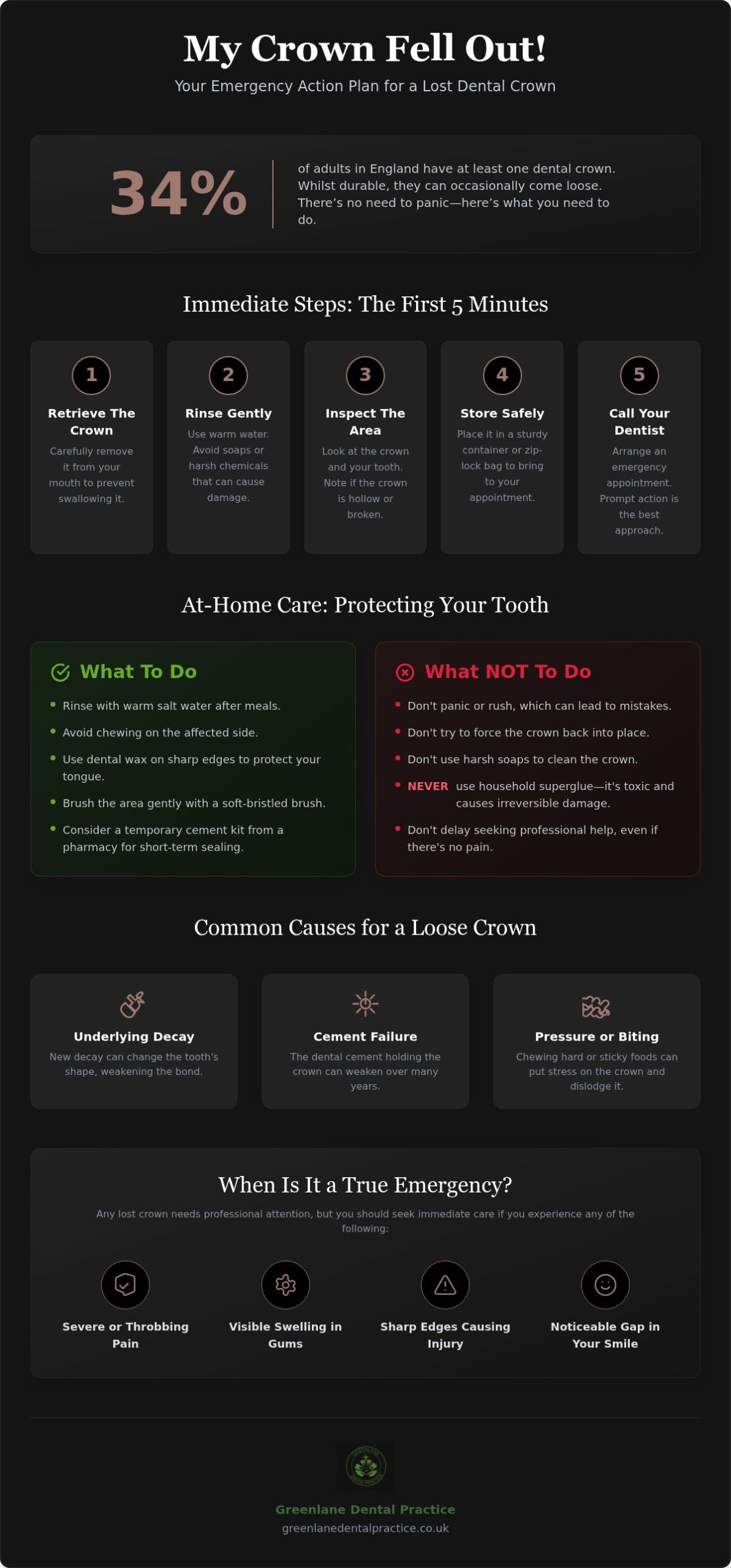
You’re halfway through a favourite meal or simply brushing your teeth when you suddenly feel a strange gap and a hard object on your tongue. It’s a moment that triggers instant worry, especially if you’re dealing with sharp sensitivity or the embarrassment of a visible gap in your smile. If your first thought is, “my crown fell out what do I do?” you aren’t alone. Data shows that 34% of adults in England have at least one dental crown, and whilst these restorations are durable, they can occasionally come loose due to age or underlying decay.
We understand how unsettling this feels, but there’s no need to panic. This guide provides a clear, step-by-step emergency plan to protect your exposed tooth and keep you comfortable whilst you wait for professional care. You’ll learn how to store your crown safely, which simple steps can soothe sensitivity, and how to secure an emergency appointment in Leigh. We’ll explain whether your crown can be saved and explore modern, natural-looking restorative options to ensure your smile feels as good as new.
Key Takeaways
- Retrieve and rinse your lost crown immediately to prevent accidental swallowing or further damage to the restoration.
- If you are panicking and wondering “my crown fell out what do I do”, discover the essential home care steps to protect your sensitive tooth from cold and air.
- Learn why crowns come loose, including the role of underlying decay and the gradual weakening of dental cement over the years.
- Explore your professional treatment options, from simple re-cementing to advanced restorative solutions like porcelain crowns or dental implants.
- Find out how to book a priority emergency appointment in Leigh for immediate pain relief and a bespoke repair plan.
Immediate Steps: What to Do the Moment Your Crown Falls Out
Losing a restoration can feel like a minor disaster, especially if it happens during a meal or right before an important event. Your first priority is to stay calm and move carefully. Panicking often leads to accidental mishaps, such as swallowing or inhaling the loose piece. If you are standing over the sink or at the dinner table wondering, “my crown fell out what do I do”, the very first step is to retrieve the restoration immediately. Once you have it in hand, rinse it gently under warm water to remove any food debris or old cement. Avoid using soaps or harsh chemicals, as these can damage the delicate internal surface of the piece.
A dental crown is a precision-engineered cap designed to protect what remains of your natural tooth structure. After you have cleaned it, take a moment to examine both the crown and the tooth stump in the mirror. Look for any obvious breaks or dark spots of decay. If the crown is hollow and looks intact, there is a good chance we can re-cement it for you. However, if part of your natural tooth is still inside the crown, the situation requires a more detailed restorative approach. Once you’ve secured the area, your next move should be to contact an emergency dentist in Leigh to arrange a professional assessment. Prompt action is the best way to ensure we can save your original restoration and protect the sensitive tissues underneath.
How to Safely Store Your Dental Crown
Proper storage is vital for a successful repair. Place your crown in a small, sturdy container or a clean zip-lock bag to keep it safe from further damage or loss. Even if the crown appears chipped or broken, you must bring it to your appointment. Our clinical team can often use the original piece as a template for a new one or, in some cases, perform a meticulous repair. Never attempt to “superglue” the crown back into place yourself. Household adhesives are toxic and can cause permanent damage to your tooth and the restoration.
Assessing the Urgency of Your Situation
Not every lost crown is a painful emergency, but some require immediate intervention. If you are experiencing severe pain, throbbing, or visible swelling in the gums, this may indicate an underlying infection that needs urgent attention. You should also consider the “social” urgency of the situation. A missing front tooth crown can cause significant embarrassment, and we prioritise these cases to restore your confidence as quickly as possible. If the remaining tooth stump is sharp and catching on your tongue or cheek, it’s essential to see us quickly to prevent painful soft-tissue trauma. Remember, whilst you might feel tempted to wait, an exposed tooth is vulnerable to bacteria and temperature changes. Acting now prevents a simple fix from turning into a complex procedure.
Protecting Your Tooth at Home: The Do’s and Don’ts
If you are staring in the mirror thinking “my crown fell out what do I do”, the next few hours are about preservation. Your exposed tooth is now vulnerable to temperature, pressure, and bacteria. To prevent discomfort, avoid chewing on that side of your mouth completely. Even soft foods can exert enough mechanical stress to fracture the weakened tooth structure that remains. We also recommend rinsing gently with warm salt water after every meal. This simple solution helps to keep the area free from debris and provides a mild antiseptic environment to discourage plaque buildup whilst the protective cap is missing.
Sometimes, the remaining tooth stump has sharp edges that can irritate your tongue or cheek, making it difficult to speak or rest comfortably. A small bead of dental wax, readily available at most Leigh pharmacies, can provide an effective barrier and prevent painful ulcers. Whilst the tooth is exposed, your hygiene routine must be meticulous but gentle. Brushing the area carefully with a soft-bristled brush ensures that decay doesn’t take hold in the days before your repair. The American Dental Association notes that crowns are vital for maintaining the structural integrity of your bite, so keeping that foundation healthy is our shared priority.
Temporary Fixes: What is Safe?
Visiting a local chemist for a temporary dental cement kit is a viable option if you cannot see us immediately. These kits are designed for short-term use and can help seal the tooth against air and cold. Only attempt re-insertion if the crown slides back on easily and your bite feels natural; never force it into place. Crucially, avoid household ‘Superglue’ at all costs. These adhesives contain toxic chemicals that can cause irreversible damage to the tooth pulp and make it impossible for us to clean the crown for re-attachment. For professional guidance, it is always safer to speak with our emergency team before attempting DIY repairs.
Temporary Crown vs. Permanent Crown
It’s important to understand the difference between a lost temporary crown and a permanent one. Temporary crowns are often fitted whilst your bespoke restoration is being crafted in a lab. They are designed with weaker cement so they can be removed easily. If one pops off, the urgency is slightly lower, though you still need a refit to prevent your teeth from shifting. However, if a permanent crown falls out, it usually indicates that the dental cement has failed or that new decay has softened the underlying structure. Leaving a tooth exposed for more than a few days invites sensitivity and potential infection. Acting quickly ensures we can often recement the original rather than starting from scratch.
Why Do Dental Crowns Come Loose? Common Causes
Understanding why a restoration has failed is the first step toward preventing it from happening again. Whilst it is easy to feel frustrated when you find yourself asking “my crown fell out what do I do”, it is important to remember that these restorations face incredible daily pressure. Statistics from the NHS suggest that 34% of adults in England have at least one dental crown; however, their longevity varies. Research indicates that at the ten-year mark, the survival rate is approximately 68% for metal crowns and 48% for all-porcelain versions. This natural lifecycle is often shortened by several common factors:
- Cement Degradation: Over several years, the medical-grade cement holding the crown in place can gradually wash away or become brittle, especially if the seal at the gumline is compromised.
- Mechanical Stress: Biting down on exceptionally hard or sticky foods, such as boiled sweets or toffee, can create a “suction” or “lever” effect that pulls the crown away from the tooth.
- Bruxism: Nocturnal teeth grinding puts immense lateral pressure on restorations. This constant shearing force eventually fatigues the bond between the crown and the natural tooth.
- Physical Trauma: A sudden impact to the mouth during sports or an accidental fall can dislodge even the most securely fitted restoration.
If you’ve experienced one of these issues, knowing what to do if your crown falls out can help you manage the immediate aftermath. However, the root cause often requires a professional diagnostic eye to ensure the underlying tooth remains viable for a new restoration.
The Role of Underlying Decay
The most frequent reason for a crown failure is secondary decay developing at the margin where the porcelain meets the natural tooth. If your oral hygiene routine isn’t perfect, bacteria can seep under the edge of the crown and begin to soften the tooth stump. Because the crown covers the tooth, this rot often progresses silently without any visible signs or pain. A fallen crown is often the first sign of a hidden cavity. When the structure that holds the crown becomes too soft or damaged, the restoration simply has nothing left to grip onto.
Fit and Fabrication Issues
Precision is the cornerstone of modern restorative dentistry. If a crown’s “bite” isn’t perfectly aligned with the opposing teeth, every chew creates a tiny amount of movement that works the restoration loose over time. Older crowns, particularly those made before the widespread use of digital impressions, are more prone to these micro-misfits. Today, we use advanced technology to ensure a flush, airtight seal that protects the tooth from bacteria. Modern materials like zirconia or E-max offer superior strength compared to traditional porcelain-fused-to-metal options, significantly reducing the risk of material fracture or bond failure.
Professional Treatment Options: Repair or Replace?
Once you arrive at our practice, our first goal is to determine if your existing restoration can be preserved. If both the crown and the underlying tooth are healthy, professional re-cementing is often a straightforward and effective solution. We meticulously clean the interior of the crown and the tooth stump to ensure a perfect bond, using medical-grade adhesives that are far superior to anything available over the counter. If you have been wondering “my crown fell out what do I do” whilst holding an intact restoration, this is the ideal outcome. However, if the crown has been damaged or the underlying tooth has changed shape due to minor wear, a core build-up may be required to create a stable foundation before the crown is refitted.
In cases where the decay discussed previously has reached the dental pulp, a root canal treatment might be necessary to clear the infection and save the natural root. This ensures that your smile remains healthy from the inside out. If the remaining tooth structure is unfortunately too weak to support any form of cap, we will discuss the most gentle and effective ways to restore your bite and confidence. If you are worried about a loose or lost crown, book an emergency assessment with our friendly team today to explore your options.
When a New Crown is Necessary
There are times when a fresh start is the best pathway to long-term comfort. If your old restoration is worn, chipped, or no longer provides a flush seal, a new bespoke crown is the safest option. You might choose between high-strength ceramics or beautiful porcelain to match your natural teeth perfectly. For those looking to enhance the aesthetics of their front teeth alongside a repair, porcelain veneers can often provide a more transformative and seamless result. We use precise impressions to ensure your new fit is comfortable and built to last.
Long-term Solutions for Non-Saveable Teeth
If a tooth cannot be saved, dental implants Leigh patients often choose are considered the gold standard. Unlike dental bridges, which rely on neighbouring teeth for support, an implant acts as a standalone root, preserving your jawbone and providing unmatched stability. To protect your investment and prevent future failures, we recommend regular EMS hygiene appointments. This advanced, pain-free system keeps the margins of your crowns and implants perfectly clean, ensuring your smile stays radiant and secure for years to come.
Emergency Dental Care at Greenlane Dental Practice Leigh
When a restoration fails, the sudden uncertainty can be overwhelming. At Greenlane Dental Practice, we prioritise our Leigh neighbours who find themselves asking “my crown fell out what do I do” by offering dedicated emergency slots throughout the week. We believe that no one should have to endure sharp sensitivity or the self-consciousness of a missing front tooth for longer than necessary. Our practice is designed to feel like a calming sanctuary rather than a sterile clinic; we provide a supportive environment that helps to alleviate the natural anxieties associated with urgent dental visits.
Our clinical team utilises state-of-the-art diagnostic tools to look beyond the surface. By identifying the precise reason why your crown failed, we can create a plan that prevents a repeat occurrence. Whether the issue was an underlying cavity or a simple fatigue of the dental cement, our transparent approach ensures you receive a clear, itemised treatment plan. We take great pride in our “patient-first” philosophy, acting as meticulous caretakers who value your unique journey toward a confident, healthy smile.
Booking Your Emergency Appointment in Leigh
If you are in distress or discomfort, please call our Leigh practice immediately to secure a same-day assessment slot. Our reception team is trained to handle urgent enquiries with both efficiency and kindness. When you speak with us, please mention if you have retrieved the crown, the level of pain you are experiencing, and if there is any visible swelling. This information allows us to prepare our clinical room and diagnostic equipment before you even walk through the door. Conveniently located in the heart of Leigh, we are easily accessible for residents across Greater Manchester who require premium, attentive emergency care.
What to Expect During Your Visit
Your visit begins with a thorough but gentle examination of both the tooth stump and the dislodged crown. If you are experiencing pain, our first priority is to provide immediate relief and stabilise the tooth to prevent further damage. Once the area is comfortable, we’ll have a relaxed, detailed discussion about your options. As we explored in previous sections, this may involve professional re-cementing or the fabrication of a new, precision-fitted restoration. We move at your pace, ensuring you feel informed and cared for without being overwhelmed by technical data. Our goal is to return your smile to its full strength and beauty, giving you the confidence to enjoy your favourite foods and socialise without worry.
Restore Your Confidence and Your Smile
A lost crown is more than just a physical inconvenience; it’s a disruption to your daily life and your self-assurance. By following the immediate steps of retrieval and protection, you’ve already done the vital work of preserving your natural tooth. Now, the final step is to transition from temporary home care to a permanent, professional solution. Whether we can recement your original restoration or you require a bespoke new crown, our goal is to ensure your bite is comfortable and your smile is seamless.
If you’re currently worrying about “my crown fell out what do I do”, remember that expert help is right here in your community. Greenlane Dental Practice is a modern, patient-focused centre in Greater Manchester, highly experienced in restorative and cosmetic dentistry. We offer dedicated emergency slots for Leigh residents to ensure you aren’t left waiting in discomfort. Our empathetic team is ready to provide the precision care you deserve in a warm, welcoming environment.
Book an Emergency Appointment at Greenlane Dental Leigh today to find the lasting relief and professional care you need. We look forward to helping you smile with complete confidence once again.
Frequently Asked Questions
Is a crown falling out a dental emergency?
A dislodged crown is considered an urgent dental matter that requires prompt attention. Whilst it may not always involve severe pain, the exposed tooth is vulnerable to rapid decay and heightened sensitivity to air or temperature. If you are panicking and wondering “my crown fell out what do I do”, the safest approach is to seek professional advice within 24 to 48 hours. Quick intervention prevents the neighbouring teeth from shifting and reduces the risk of needing more complex restorative work.
Can I glue my crown back in with Superglue?
You should never use household Superglue or any non-medical adhesive to refix a restoration. These substances contain toxic chemicals that can cause irreversible damage to the living pulp inside your tooth. Additionally, household glues are nearly impossible for a dentist to remove safely. Attempting a DIY repair with the wrong materials often prevents us from being able to recement the original restoration, leading to the avoidable cost of a new crown.
What happens if I accidentally swallow my dental crown?
Most swallowed crowns pass through the digestive system naturally without causing any harm. However, you should seek medical advice immediately if you suspect you have inhaled the crown or if you experience any chest pain or difficulty breathing. If you are certain it was swallowed, it is usually a matter of waiting for it to pass. Most patients prefer to have a new restoration made rather than attempting to retrieve and sterilise a swallowed piece.
How long can I wait to see a dentist after my crown falls off?
You should aim to see a dentist within 48 hours of the crown falling off. Leaving the tooth exposed for longer than a few days allows bacteria to accumulate on the weakened structure, significantly increasing the risk of infection. Another concern is that neighbouring teeth can begin to shift into the empty space. If this movement occurs, it may become impossible to fit the original crown back onto the tooth stump comfortably.
Will it hurt when the dentist puts the crown back on?
Re-cementing a crown is typically a painless and straightforward procedure that requires no recovery time. If the underlying tooth is particularly sensitive to air or touch, we can apply a local anaesthetic to ensure you remain completely relaxed. Most patients find the process involves nothing more than a little bit of pressure as the restoration is gently secured back into place using medical-grade cement.
Can a crown be re-used if it falls out?
A crown can often be re-used if the restoration itself is intact and the underlying tooth structure remains healthy. Our team will meticulously clean the old cement from the interior of the crown and check the fit using modern diagnostic tools. If there is new decay present or the crown has been fractured, we will discuss crafting a bespoke new porcelain or ceramic replacement to ensure a long-lasting result.
How much does it cost to fix a fallen crown in the UK?
The cost depends on whether you receive treatment through the NHS or a private practice. As of April 2026, the NHS charge for urgent treatment, which includes refixing a crown, is £27.90. Private recementing in the UK typically starts from approximately £95. If a new crown is required, NHS Band 3 costs £332.10, whilst private options generally range from £600 to £1,200 depending on the complexity and the materials used.
How can I prevent my other crowns from falling out?
Excellent oral hygiene is the most effective way to protect your other restorations from failure. Focus on cleaning the margin where the crown meets the gumline to prevent secondary decay from softening the foundation. Regular check-ups and advanced EMS hygiene appointments help us catch early signs of cement wear before the crown comes loose. You should also avoid biting down on exceptionally hard objects like ice, which can fatigue the dental bond.