Not every Invisalign patient needs attachments. If you’re asking, “Do I need Invisalign attachments?”, it depends on the tooth movements planned for your treatment: some people need them, while others don’t. These small, tooth-coloured composite shapes are bonded to selected teeth so aligners can grip and guide movement.
It’s understandable to wonder whether attachments will show when you smile or make treatment more complicated. They can be noticeable up close, particularly on front teeth, but their purpose is practical: they help guide movements that aligners alone may not manage as effectively. This article explains how attachments work, why they’re recommended for some patients but not others, and what they may look like. Selective placement reflects planning for the movement each tooth needs, rather than a one-size-fits-all approach.
Key Takeaways
- Attachments give aligners a surface to grip, helping guide tooth movements that may be harder to achieve with trays alone.
- Whether you need attachments depends on the movements in your treatment plan; some patients need only a few, while others need more.
- Tooth-coloured attachments can be more noticeable on front teeth, but their placement and shape are tailored to the planned movement.
- Selective placement can reflect planning for specific teeth, rather than a need to attach every tooth.
- Attachments are temporary and are removed after treatment, with the remaining composite polished from the teeth.
Does selective attachment placement mean better Invisalign planning?
Selective placement can show that each attachment has a purpose in the planned tooth movement. Invisalign treatment planning uses 3D scans to simulate stages of movement and identify where attachments may improve accuracy or stability. Their shape, size, angle and position are chosen for the movement required, rather than applied uniformly across every tooth.
Fitting follows a measured process. The selected tooth is prepared before the composite resin is placed and set. The process is similar to placing a composite filling, and fitting Invisalign attachments typically takes around 30 minutes. The clear aligners have matching contours that fit around the attachments, helping direct force as the teeth move.
At the end of treatment, attachments are designed to be temporary. The dentist removes the composite with dental instruments, then polishes the tooth to smooth away any remaining resin. An attachment can be removed in a few seconds, while the full appointment allows the dentist to work around the other teeth and check the result.
Removal is intended to take off the bonded material, not the tooth surface. Invisalign attachments are described as safe, and removal by a dentist is stated not to harm enamel. Don’t try to scrape or pull one off yourself: dental tools and polishing help control the process and remove leftover composite resin.
After removal, your teeth may feel different because the raised composite is gone. Retainers help hold teeth in their new positions after orthodontic treatment, so follow the retention plan provided with your care. Ask how and when to wear your retainer during the treatment handover, and keep it clean alongside your usual oral hygiene routine.
Do Invisalign attachments cost extra in the UK? The cost depends on your case and is provided after a quote request. It may vary with the treatment plan and what the agreed fee includes. Attachments are part of the aligner mechanics, so the treatment agreement explains how fitting and removal are covered.
Are attachments included in NHS or private orthodontic treatment in the UK? There isn’t one inclusion rule that applies to every NHS and private arrangement. The treatment plan and fee agreement set out what the chosen care includes, including any attachment work.
Attachments can cause minor soreness or tenderness as your teeth adjust to pressure. Aligners may also take more effort to remove because they fit around the bonded shapes. Brush and floss around each attachment daily to clear away food and plaque. If one comes off, keep wearing your aligner as normal and contact your dentist to arrange a replacement.
Do Attachments Affect How Aligners Look?
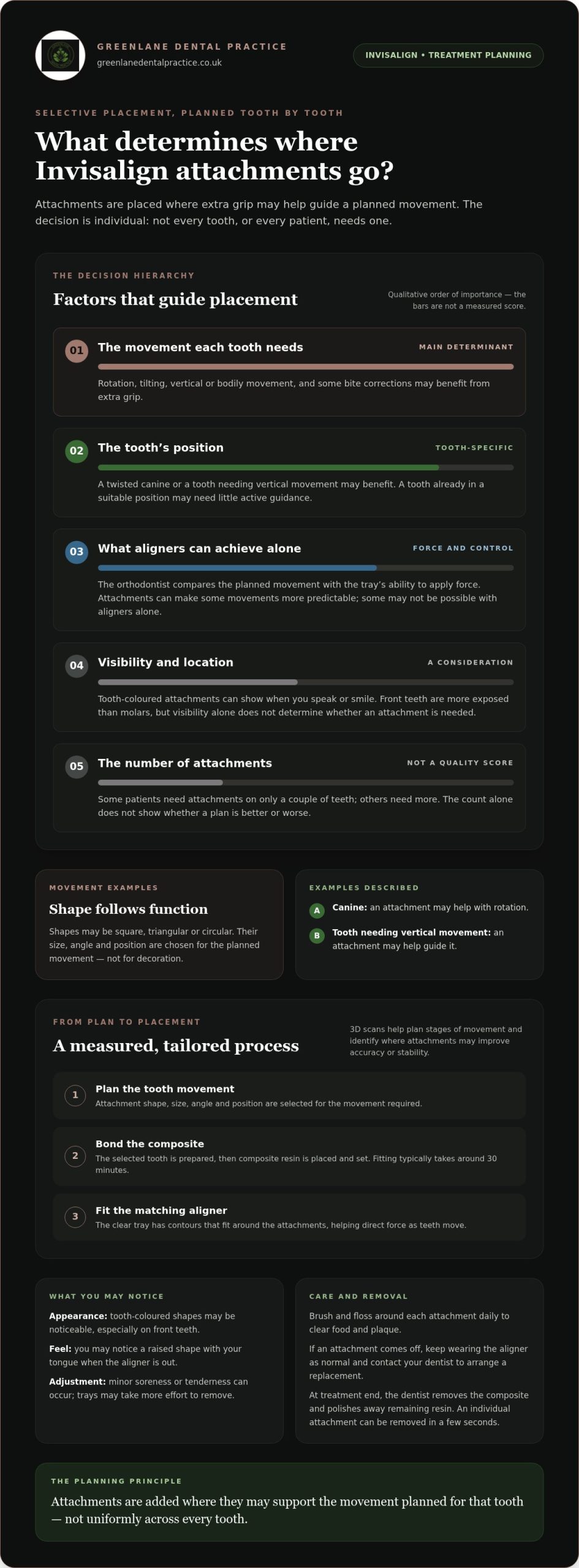
An orthodontist decides by comparing the planned tooth movement with what aligners can achieve alone. They consider which teeth need rotation, vertical or bodily movement, or bite correction, then place attachments where extra grip can help guide those changes.
Attachments are made from tooth-coloured composite resin and shaped to suit the treatment plan. They can be square, triangular or circular, with their angle and position chosen for the movement required. For example, an attachment may help rotate a canine, while another may help move a tooth vertically. The shape is functional, not decorative.
Because attachments sit on the tooth surface, they can show when you speak or smile. Their tooth-coloured material helps them blend with natural enamel, but front teeth are more exposed than molars. A small attachment on a front tooth may therefore be easier to notice than one towards the back. Clear aligners don’t make every part of treatment invisible.
Placement is selective because teeth don’t all need the same movement. A tooth already in a suitable position may need little active guidance, while a twisted canine or a tooth needing vertical movement may benefit from an attachment. Some patients need attachments on only a couple of teeth; others need more. The aim is to add support where it helps with the planned movement, rather than place attachments uniformly.
The number of attachments alone doesn’t show whether a plan is better or worse. Their location, visibility and purpose matter. For example, a plan may use an attachment on a less visible premolar for anchorage, or on a front tooth where extra grip supports a particular movement. A straightforward plan can still require an attachment, while a more complex plan may use them selectively.
Attachments can make certain tooth movements more predictable, including rotations and some bite corrections. Some movements may not be possible with aligners alone, so the orthodontist weighs the expected movement against the aligner’s ability to apply force without an attachment. The decision depends on each tooth’s position and planned movement, not simply on how visible an attachment might be.
If you’re considering clear aligners, an individual assessment of tooth movement can help explain where attachments may be placed and why. That discussion connects the planned movement with what you may see when wearing your trays.
What Invisalign attachments are and how they guide teeth
Invisalign attachments are small composite resin shapes bonded to selected teeth during Invisalign treatment. They give aligners extra grip for particular movements, including rotation, tilting and vertical movement.
Attachment shape and feel
Attachments are small, tooth-coloured shapes bonded to the front surface of selected teeth. Their shape may be square, triangular or circular, depending on the planned movement. You may see a slight raised shape when your aligner is out and feel it with your tongue. With the tray fitted, its contours sit around the attachments.
The composite resin is similar to material used for some dental fillings. Its raised profile is functional: it gives the aligner a point to push against. You may notice a textured surface when you touch the tooth, rather than smooth enamel.
How attachments guide aligners
Attachments help aligners apply force in a more controlled direction. The tray fits around each shape, allowing it to grip the tooth and guide movement as you wear it. Without that contact, an aligner may not apply the force needed for a particular adjustment.
For example, an attachment can help rotate a twisted tooth or guide a tilted tooth towards a better position. It can also support vertical movement, such as pulling down a tooth that hasn’t fully erupted. Each attachment’s position and shape are chosen to suit its planned purpose.
Teeth that may need attachments
The number of teeth with attachments depends on the individual malocclusion and planned movements. A patient may need attachments on every tooth or just a couple. Teeth that need more significant movement are more likely to need extra grip, while others may move with aligners alone.
Premolars may be used for anchorage, helping support movement in other teeth. Attachments can also assist with some bite corrections, root shifts and tooth rotations. At a consultation, the dentist can explain which teeth need attachments and the purpose of each one.
Vertical movement shows why the treatment plan matters. An aligner must grip the tooth to guide it up or down, rather than simply press against its crown. Attachments can provide that grip, while the tray directs the planned force. If a tooth needs only a small positional change, the extra grip may not be necessary.
Attachments work alongside consistent aligner wear. Each tray is shaped for a stage of treatment, and its contours engage the attachments to guide the intended movement. Together, they can address movements that may be difficult with a smooth tooth surface alone.
How visible attachments are
Invisalign attachments are small, tooth-coloured composite shapes, usually only a few millimetres across. Their colour helps them blend with natural teeth, although they aren’t completely invisible. At close range, you may notice a raised shape, particularly when the clear aligner is out. Visibility depends partly on which teeth carry attachments.
Position makes a difference. An attachment on a front tooth may be more visible when you smile or speak than one on a molar further back. For example, a small shape near the edge of a visible incisor may catch the eye more readily than one hidden behind your cheek. The material is tooth-coloured in either position.
With an aligner fitted, the tray covers the attachment and has a matching contour around it. The added shape may still show through the clear plastic, especially on front teeth, but the composite is designed to blend with enamel. Clear aligners are discreet, but that doesn’t mean every part of treatment will be undetectable.
Attachment shapes vary according to the planned movement. A square, triangular or circular form may be selected for its position and angle, not to create a particular cosmetic effect. The digital treatment plan guides where each shape is placed to support the intended movement. Appearance and function are considered together.
Unlike braces, attachments don’t form a continuous row of brackets and wires. Instead, the dentist bonds separate composite shapes to selected teeth. Their overall appearance is different, but an attachment on a front tooth can still be noticeable in close conversation or in a photograph. A molar attachment is generally less exposed when you smile.
Colour can also affect how clearly an attachment stands out. Coffee, red wine and curry can stain around attachment edges, while smoking can contribute to discolouration. Brush and floss around the bonded shapes daily to remove food and plaque. Keeping aligners and attachments clean helps them remain discreet throughout treatment.
When reviewing a treatment plan, consider both the number and location of attachments. A few on back teeth may be less visible than one on a front tooth. The dentist can show you which teeth need attachments and explain how each placement supports movement. This helps you understand what to expect with and without your aligners.
Whether every Invisalign patient needs attachments
No. Invisalign patients don’t all need attachments: some treatment plans use none, while others include them on a few teeth or every tooth. The deciding factor is the movement required, not simply the choice to wear clear aligners. A tooth needing a more significant adjustment may need the extra grip an attachment provides.
For example, a slightly crowded tooth needing a small positional change may move with an aligner alone. A twisted canine, a tooth that must move vertically, or one requiring a root shift may need more controlled force. Attachments give the aligner a shaped surface to engage, helping direct pressure towards the planned movement.
An orthodontist considers the position of each tooth and the movement required through the treatment stages. Invisalign planning uses 3D scans to simulate tooth movement and identify where attachments may improve accuracy or stability. This means the plan can place an attachment on one tooth but leave a neighbouring tooth without one, even when both sit in the same part of the mouth.
The number and shape of attachments vary with the individual malocclusion. One patient may need them on only a couple of teeth; another may need them on every tooth. Premolars may provide anchorage, while an attachment on a canine can help with rotation. The pattern reflects different purposes, rather than a standard template for every smile.
What if you’d prefer to go without an attachment? If the orthodontist recommends one as necessary, leaving it out may limit treatment effectiveness. Some slight tooth movements may not be possible without attachments, and treatment may take longer. The orthodontist should explain the expected consequences for your individual results, including what the aligner can and cannot achieve without that support.
Attachments aren’t a sign that Invisalign is unsuitable or that every tooth needs extra assistance. They’re a tool for particular movements. A plan with fewer attachments isn’t automatically better: what matters is whether the aligners can move each tooth properly with the prescribed support. If an attachment is needed for a tooth’s planned movement, removing it from the plan changes how the aligner applies force.
During a treatment discussion, focus on the reason for each proposed placement. Ask which movement it supports, why that tooth needs assistance, and what changes if it’s left without an attachment. Those points make the plan easier to understand and help you weigh appearance against treatment mechanics. Discuss your clear aligner treatment plan to understand how attachments relate to your teeth’s planned movement.
Greenlane Dental Practice: Invisalign Clear Aligners
Greenlane Dental Practice offers Invisalign Clear Aligners for people exploring a discreet way to straighten their teeth. If you’re considering attachments, discussing your teeth and planned movements can clarify why particular shapes may be included and how they support aligner fit and movement.
Bring your questions about which teeth may need attachments, how they could look, and what happens at the end of treatment. Understanding the reasoning behind a personalised plan can help you feel informed before deciding how to proceed with clear aligners.
Contact Greenlane Dental Practice to discuss Invisalign Clear Aligners and ask your questions about attachments.
Take the next step with confidence
Your treatment conversation can cover more than whether attachments are visible. If you’re still asking, “Do I need Invisalign attachments?”, raise that concern alongside what you want to change about your smile. Discussing your priorities helps you understand how the proposed plan relates to your goals, so you can make a considered decision rather than judging treatment by appearance alone.
Greenlane Dental Practice offers Invisalign Clear Aligners, as well as Porcelain Veneers and Professional Teeth Whitening for different smile goals. These options serve different purposes, so the right conversation depends on whether you’re considering tooth position, shape or colour. Contact Greenlane Dental Practice to discuss your questions and explore a suitable next step. You deserve to feel informed and comfortable as you decide how to move forward.
Frequently Asked Questions
Quick answer: What are Invisalign attachments?
Invisalign attachments are small pieces of tooth-coloured composite bonded to selected teeth during aligner treatment. They give trays extra grip to guide planned movements. For example, a shaped attachment can help an aligner apply force to a rotated tooth. Attachments are temporary, and a dentist removes them when treatment finishes. Their number and position depend on the movements needed, rather than a standard layout for every patient.
Will they hurt?
Having attachments fitted is described as a simple procedure, and mild tenderness can occur as your teeth adjust to pressure from the aligners. This discomfort is usually short-lived. Trays may also take more effort to remove because they fit around the attachments. Use both hands and start at the back teeth when removing an aligner, rather than pulling sharply from the front.
Are attachments visible when smiling?
Attachments can be visible, particularly on front teeth, although tooth-coloured composite helps them blend with your enamel. With a clear tray in place, an attachment may still show through the plastic. A back-tooth attachment is less exposed in a smile than one on an incisor. Coffee, red wine and curry can stain around attachment edges, so cleaning matters.
Can I choose not to have attachments?
You can discuss your concerns with your orthodontist, but declining an attachment recommended as necessary may limit the planned tooth movement. Some movements may not be achievable with aligners alone, and treatment may take longer without the added grip. Ask what the aligner is expected to do on that specific tooth without the attachment. This gives you a clearer basis for discussing options and likely effects on your treatment result.
Do they stay on permanently?
No, Invisalign attachments are temporary and are removed after aligner treatment. A dentist removes the bonded composite and polishes the tooth to clear any remaining resin. Removal is intended to take away the attachment, not damage the enamel. Retainers may be part of the next stage of care, helping maintain tooth positions after treatment. Follow the retainer instructions provided for your treatment plan.
How Do You Care For the Invisalign Attachments at Home?
Brush and floss around each attachment daily, paying attention to the edges where plaque and food can collect. Keeping aligners clean also helps reduce staining and discolouration. Coffee, red wine, curry and smoking can stain around attachments; smoking can also darken trays. If an attachment comes off, contact your dentist for advice.
What are Invisalign attachments and how do they work?
Attachments are bonded composite shapes that work with matching contours inside the aligner. Once the tray is seated, it engages the attachment and applies force in a planned direction. This can help guide movements such as rotation, vertical adjustment or bite correction. The attachment isn’t a separate appliance: it works as part of the aligner system, so wear the trays according to your dentist’s schedule.
Does everyone who gets Invisalign need attachments?
No. Some patients have no attachments, while others need a few or several, depending on their teeth and planned movements. For instance, someone needing slight alignment may have different requirements from a patient whose canine needs rotation. The number alone doesn’t indicate whether treatment is more or less suitable. Your orthodontist can explain the purpose of each placement and the effect of leaving it out.