A missing tooth is far more than a simple gap in your smile; it’s a silent architect that can gradually reshape your entire facial structure. Whilst it’s easy to focus on the self-consciousness you feel when laughing or the frustration of avoiding your favourite foods, the underlying impact on your oral health is often more significant. You’ve likely wondered about the best way to replace a missing tooth that won’t just look natural but will also protect your surrounding teeth from shifting. It’s a common concern, particularly as research indicates that up to 23% of adults with missing teeth are now choosing advanced restorative options over traditional alternatives to maintain their long-term stability.
We understand that you want a solution that feels like a part of you, not just a temporary fix. In this 2026 guide, you’ll discover the most reliable, natural-looking treatments available today and learn how to choose the right path for your unique lifestyle and health needs. We’ll explore everything from the precision of modern dental implants to the latest advancements in bridges and dentures, ensuring you have a clear understanding of how to reclaim your confidence and your bite with total peace of mind.
Key Takeaways
- Understand why replacing a gap quickly is essential for maintaining your jawbone density and natural facial aesthetics.
- Discover why dental implants are the premier choice for a long-term, biocompatible solution that mirrors the function of your natural teeth.
- Evaluate the differences between fixed bridges and partial dentures to identify the best way to replace a missing tooth for your lifestyle.
- Gain insight into the modern restoration process, including the role of advanced digital imaging and bespoke treatment planning.
- Learn how a supportive, community-focused dental environment in Leigh can help you overcome anxieties and achieve a healthier, more confident smile.
Beyond the Gap: Why Replacing a Missing Tooth is Vital for Your Health
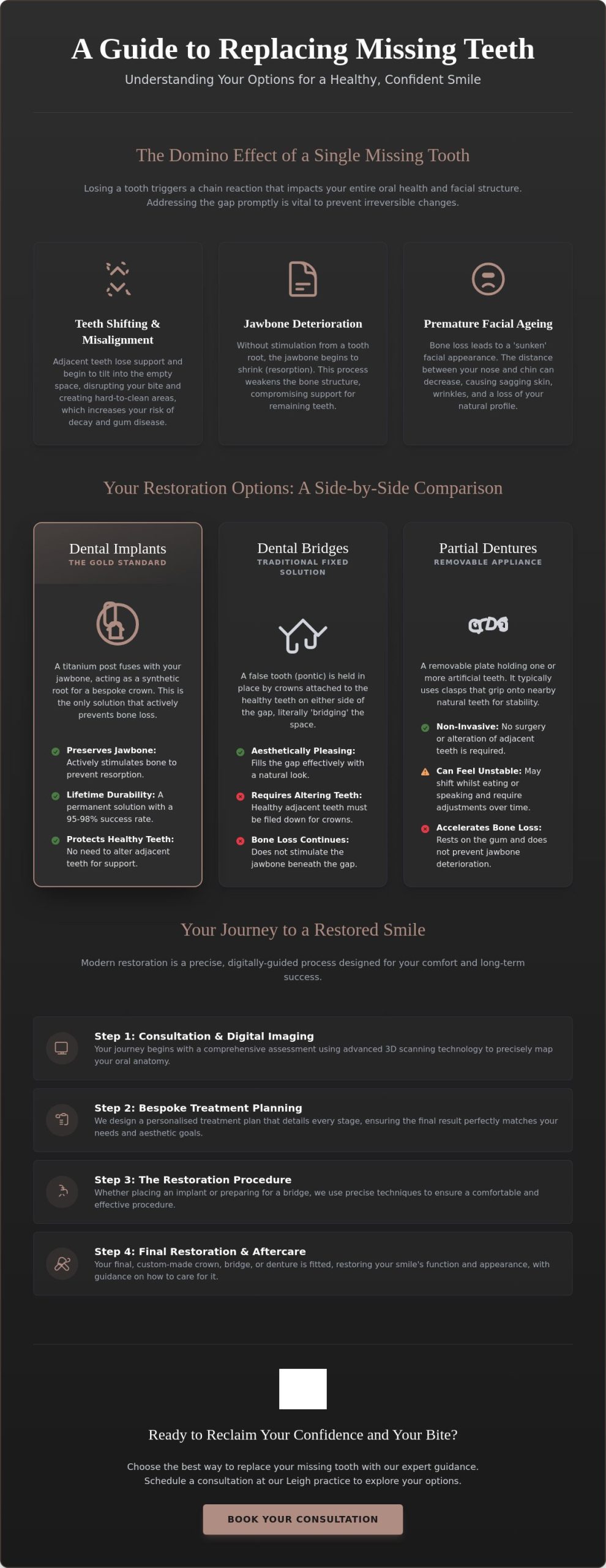
Losing a tooth might feel like a minor inconvenience if it’s tucked away at the back of your mouth, but your teeth function as a collective unit. When one is missing, the entire balance of your bite is thrown into disarray. It’s a biological necessity to seek out the best way to replace a missing tooth, as leaving a gap can trigger a series of events that compromise your oral health and your facial appearance. Your mouth is a delicate ecosystem; when one part fails, the others must compensate, often at a significant cost to their own longevity.
Without the support of a full set of teeth, the remaining ones are forced to bear a disproportionate amount of pressure during everyday activities like chewing or speaking. This extra strain often leads to micro-fractures, accelerated wear, and even the eventual loss of more teeth. It’s a heavy burden for your smile to carry, and over time, the increased workload can lead to jaw pain and headaches that you might not initially link to that single missing tooth.
The “Domino Effect” of Tooth Loss
Your teeth are naturally designed to support one another, acting as placeholders that keep the dental arch stable. When a gap appears, the adjacent teeth no longer have that vital lateral support. They begin to tilt and drift into the empty space, a process that can permanently alter your bite. This misalignment creates awkward nooks and crannies where plaque and bacteria can easily hide, making your daily brushing routine less effective.
Because these shifted teeth are harder to clean, your risk of decay and gum disease increases significantly. Whilst you consider your long-term restorative plan, maintaining the health of your remaining teeth is paramount. Professional EMS hygiene treatment can be incredibly helpful during this transition, using advanced airflow technology to keep those hard-to-reach areas pristine and healthy.
Preserving Your Facial Structure
Perhaps the most hidden consequence of tooth loss happens beneath the surface of your gums. Your jawbone is a living tissue that requires constant stimulation from the pressure of chewing to remain dense and strong. When a tooth root is no longer present, that stimulation stops. Bone resorption is the process where the body reabsorbs unused minerals from the jaw, causing the bone to shrink and weaken.
Over time, this loss of bone volume leads to a “sunken” facial appearance. The distance between your nose and chin can decrease, causing the skin to sag and creating an appearance of premature ageing. Researching the options for replacing missing teeth is about more than just filling a hole; it’s about providing the structural support your face needs to stay vibrant. Finding the best way to replace a missing tooth early on helps prevent this irreversible bone loss, keeping your smile and your profile looking youthful and healthy.
Dental Implants: Why They Are the Gold Standard in 2026
Modern dental implants boast an impressive success rate of between 95% and 98%, making them the most reliable long-term choice for patients today. Whilst other treatments focus on the visible portion of the smile, implants go deeper to address the structural integrity of your mouth. Many clinicians agree that an implant is often the best way to replace a missing tooth because it’s the only restorative option that actively prevents the bone loss we discussed in the previous section. By mimicking the natural relationship between a tooth and the jaw, implants provide a foundation that feels entirely authentic.
The secret to this stability lies in a biological process called osseointegration. This occurs because the implant is made from medical-grade titanium, a highly biocompatible material that the human body doesn’t just accept, but actually fuses with over time. Once the jawbone grows around the implant, it becomes a permanent part of your anatomy. This creates a secure anchor that won’t slip or shift, allowing you to speak and eat with total confidence.
The Anatomy of a Modern Dental Implant
An implant isn’t a single piece; it’s a sophisticated three-part system designed for precision and longevity. The process begins with the titanium post, which acts as a synthetic tooth root. This is followed by the abutment, a small connector that sits atop the post. Finally, a bespoke porcelain crown is securely attached. This crown is meticulously colour-matched to your natural teeth, ensuring the final result is indistinguishable from the rest of your smile.
Unlike traditional bridges, which require the filing down of healthy adjacent teeth for support, implants function independently. Harvard Medical School discusses the distinct differences between implants and bridges, highlighting how implants provide a standalone solution that preserves your remaining natural tooth structure. This “neighbour-friendly” approach ensures that your overall oral health remains uncompromised.
Are You a Candidate for Implants?
Most adults are excellent candidates for this treatment, provided they have good gum health and sufficient bone density to support the titanium post. A common misconception is that age is a barrier to restorative surgery, but the reality is that your general health and jawbone quality are far more important factors than the date on your birth certificate. Even if you’ve experienced some bone loss, modern techniques like bone grafting can often prepare the site for a successful placement.
If you’re considering this life-changing treatment, exploring our detailed guide to dental implants Leigh will help you understand the specific steps involved in our local practice. Taking the time to discuss your goals with a professional is the first step toward a permanent, beautiful smile. If you’re ready to explore your options, a friendly consultation can help determine if an implant is the right path for you.
Comparing Your Options: Dental Bridges vs. Partial Dentures
Choosing the right path for your smile is a deeply personal decision. Whilst we’ve established that implants offer a permanent anchor, they may not be the immediate choice for every patient. The best way to replace a missing tooth often comes down to balancing your clinical needs with your daily routine and budget. For many, this means choosing between the fixed stability of a dental bridge or the versatile flexibility of a modern partial denture. Both solutions have evolved significantly by 2026, offering aesthetic results that were difficult to achieve just a decade ago.
When considering the various options for replacing a missing tooth, it’s helpful to weigh the convenience of a fixed appliance against the flexibility of a removable one. A bridge is “set and forget,” much like a natural tooth, whereas a denture requires a different cleaning ritual. Your choice will impact how you eat your favourite foods and how much time you spend on maintenance each evening. We’re here to help you navigate these lifestyle factors with clarity and kindness.
Fixed Dental Bridges: Stability and Speed
A dental bridge is a fixed restoration that literally bridges the gap left by a missing tooth. It’s a popular choice for those who want a solution that doesn’t move. To create this stability, we use the healthy neighbouring teeth as anchors, or “abutments.” These teeth are gently prepared and fitted with crowns, which then support the prosthetic tooth in the centre. The result is a beautiful, porcelain finish that blends perfectly with your natural smile.
Because the bridge is bonded in place, it feels incredibly secure. You won’t have to worry about it shifting whilst you speak or enjoy a meal. However, it’s worth remembering that this process involves modifying healthy teeth to provide support. If those neighbouring teeth are already in need of crowns, a bridge can be an efficient way to address multiple concerns at once.
Modern Partial Dentures: A Versatile Choice
Partial dentures are a removable, cost-effective alternative that can replace one or several missing teeth. Gone are the days of bulky, uncomfortable “false teeth.” Modern materials like cobalt-chrome and advanced acrylics allow for a much slimmer, more comfortable fit. Dentures are a fantastic non-surgical option, especially for patients who may have lower bone density and wish to avoid grafting procedures.
One of the greatest benefits of a partial denture is its adaptability. If you happen to lose another tooth in the future, it’s often possible to add a new tooth to your existing denture. This makes it a proactive choice for long-term dental management. Whilst they do require removal for cleaning, the latest designs are discreet and stay firmly in place using subtle, tooth-coloured clasps that ensure your confidence remains high throughout the day.
The Journey to Restoration: What to Expect During Your Treatment
Reclaiming your smile is a collaborative process that extends far beyond a single clinical appointment. It’s a journey of transformation that requires a blend of advanced technology and a deeply personal touch. Determining the best way to replace a missing tooth isn’t just about selecting a prosthetic; it’s about understanding how that solution fits into your daily life and long-term health. We view every patient as a partner, ensuring you feel informed and supported from your very first visit to our Leigh practice.
A successful restoration is built on a foundation of precision and patience. Whilst it’s tempting to seek the fastest fix, we focus on outcomes that stand the test of time. This means allowing for a dedicated healing phase, especially if you’ve chosen the permanent stability of a dental implant. By giving your body the time it needs to adapt, we ensure your new tooth feels as natural and secure as the ones you were born with.
Step 1: The Comprehensive Assessment
Every restorative journey at Greenlane begins with a thorough clinical examination. We don’t just focus on the gap; we look at the health of your entire mouth, including your gums and the alignment of your neighbouring teeth. This holistic approach ensures that any restoration we place is supported by a healthy environment, reducing the risk of future complications.
During this phase, we’ve replaced the messy, uncomfortable traditional impressions of the past with high-precision digital scans. These intraoral scanners create a detailed 3D map of your mouth, allowing us to plan your treatment with incredible accuracy. From this data, we craft a bespoke treatment plan that outlines every step of your care, tailored specifically to your aesthetic goals and lifestyle requirements.
Managing Anxiety and Comfort
We understand that the fear of invasive surgery or dental pain is a significant barrier for many. Our “Empathetic Expert” team is dedicated to changing that narrative. We take pride in creating a warm, domestic atmosphere that feels more like a supportive community than a sterile medical centre. We organise your appointments to suit your personal schedule, ensuring you always have enough time to ask questions and feel completely at ease.
When it comes to the procedure itself, we address the common worry of “will it hurt?” with modern local anaesthetic and gentle, precise techniques. Our clinicians are highly skilled in minimally invasive methods that prioritise your comfort throughout. We focus on a calm, methodical pace that mirrors a relaxed consultation, ensuring you feel cared for and respected at every stage. If you’re ready to start your journey, you can book a routine dental examination to discuss your options with our friendly team.
Restoring Your Smile at Greenlane Dental Practice in Leigh
Greenlane Dental Practice is more than just a clinical setting; it’s a dedicated centre of excellence where restorative precision meets the genuine warmth of a local community. We believe that everyone deserves a smile that functions as beautifully as it looks. By housing routine examinations, emergency care, and specialist restorative treatments under one roof, we provide a seamless experience that respects your time and your comfort. Our commitment to using premium, high-end materials like porcelain and composite ensures that your results are durable, lifelike, and perfectly suited to your anatomy.
Finding the best way to replace a missing tooth is a significant milestone in your personal health journey. We’re here to guide you through that choice with clarity and kindness, ensuring you never feel like just another number. Our team takes immense pride in the quality of our work, treating every restoration as a vital pathway to renewed personal confidence. We’ve created an environment that feels like a supportive community rather than a sterile medical office, helping to alleviate the anxieties often associated with dental surgery.
Why Leigh Patients Choose Greenlane
Our patients in Leigh value the unique combination of clinical authority and neighbourly care that defines our practice. We understand that a missing tooth often comes with aesthetic concerns that extend beyond the gap itself. This is why we frequently integrate restorative treatments with subtle cosmetic tweaks, such as teeth whitening Leigh, to ensure your entire smile looks its absolute brightest. Our patient-first philosophy is built on transparent communication, ensuring you understand every aspect of your bespoke treatment plan before we begin.
Your Next Steps to a Full Smile
The journey to a complete, healthy smile begins with a simple conversation. We invite you to book a consultation where we can explore the best way to replace a missing tooth based on your specific clinical needs and lifestyle goals. If your tooth loss was sudden or traumatic, remember that we also provide dedicated emergency dentist Leigh services to provide immediate relief and help you plan your long-term restoration.
Your confidence is within reach. Whether you’re seeking the permanent stability of a dental implant or the versatile fit of a modern bridge, our team is ready to welcome you into our care. Contact Greenlane Dental Practice today to book your restorative consultation.
Begin Your Journey to a Complete Smile
Reclaiming your smile is a decision that impacts your oral health, facial structure, and daily confidence. We’ve explored how modern restorations do more than fill a gap; they protect your jawbone and keep your remaining teeth in perfect alignment. Whether you choose the permanent stability of a dental implant or the elegant speed of a porcelain bridge, taking action today prevents the long-term complications of bone resorption.
As an established Leigh practice with decades of community service, we combine this clinical expertise with advanced digital scanning and EMS hygiene technology. We’re proud to offer a supportive environment where your comfort is our priority, whether you’re seeking a single tooth replacement or a complete cosmetic smile makeover. Finding the best way to replace a missing tooth is a personal process, and our team is ready to guide you with kindness and precision.
Book your restorative consultation at Greenlane Dental Practice to discover the right solution for your lifestyle. We look forward to welcoming you into our community and helping you smile with total peace of mind.
Frequently Asked Questions
How much does it cost to replace a missing tooth in the UK?
Private costs for tooth replacement in the UK vary significantly depending on whether you choose a removable denture, a fixed bridge, or a permanent dental implant. Each solution involves different materials and clinical time. For those receiving treatment via the NHS, a Band 3 charge of £332.10 (as of April 2026) covers basic bridges or dentures, though it’s important to remember that dental implants are rarely available through the NHS.
Is a dental implant better than a bridge for a single missing tooth?
A dental implant is widely considered the best way to replace a missing tooth because it preserves the health of your entire mouth. Unlike a bridge, which requires the permanent filing down of healthy neighbouring teeth for support, an implant stands independently. It also provides the necessary stimulation to your jawbone to prevent bone loss, a benefit that bridges and dentures cannot offer.
Can I leave a gap if the missing tooth is at the back of my mouth?
Leaving a gap, even at the back of your mouth, can trigger a “domino effect” where adjacent teeth begin to tilt and drift into the empty space. This movement can lead to bite problems, jaw pain, and increased difficulty when cleaning, which raises the risk of future decay. Even if the gap isn’t visible, the underlying jawbone will still begin to shrink without a tooth root to support it.
How long does the process of getting a dental implant take?
The entire process typically takes between three and six months to ensure the most stable and long-lasting result. Most of this time is dedicated to a healing phase called osseointegration, where your jawbone naturally fuses with the titanium implant post. This patient, methodical approach is essential for creating a foundation that can support the pressure of chewing for decades to come.
Are dental implants available on the NHS?
Dental implants are very rarely available on the NHS and are typically reserved for patients with exceptional medical needs, such as those recovering from oral cancer or severe facial trauma. For the vast majority of patients, implants are a private restorative option. We provide detailed, transparent information during your consultation to help you understand the investment and the life-changing benefits this treatment offers.
What is the most natural-looking way to replace a front tooth?
A dental implant combined with a bespoke porcelain crown is the premier choice for a natural-looking front tooth restoration. Because the implant sits within the gumline, the new tooth appears to emerge naturally from the tissue just like your original teeth. Our clinicians use advanced digital colour-matching to ensure the porcelain matches the translucency and shade of your unique smile perfectly.
How do I clean and maintain a dental bridge or implant?
You should care for your restoration much like your natural teeth, with twice-daily brushing and regular interdental cleaning. For bridges, you’ll use specialised floss or brushes to clean the space beneath the prosthetic tooth. Regular professional EMS hygiene appointments are also vital to keep the surrounding gums healthy, ensuring your restoration remains secure and beautiful for the long term.
Can I get a dental implant if I have gum disease?
Active gum disease must be fully treated and stabilised before an implant can be placed, as infection can lead to treatment failure. If you’re currently managing gum issues, our first step is to restore your oral health through a tailored hygiene programme. Once your gums are healthy and your jawbone is stable, we can then safely proceed with your dental implant journey.