A dental implant isn’t a cosmetic luxury; it’s a functional joint replacement for your mouth. If you’ve spent evenings quietly scanning restaurant menus in Leigh for dishes that won’t hurt, or hiding your laugh behind a hand, you’ve likely asked yourself: are dental implants worth it? It’s completely natural to hesitate. Sorting through private dental options can feel confusing, and worries about procedure discomfort or choosing the wrong treatment often leave people feeling stuck.
You deserve honest clarity before making a decision about your health. Discover if dental implants are the right investment for your health, confidence, and lifestyle in this comprehensive expert guide. We’ll explore how modern implant techniques restore your natural bite, safeguard your facial structure, and provide a lasting, lifelike replacement that lets you enjoy life without a second thought.
Key Takeaways
- Understand how replacing missing roots protects your jawbone from shrinkage, preserving your natural facial structure and youthful profile.
- Find clarity on the question: are dental implants worth it? Compare their lifelong stability against the ongoing upkeep and enamel reduction required for traditional bridges.
- Explore how osseointegration allows titanium fixtures to fuse naturally with bone, returning your full, comfortable chewing strength.
- Learn what determines your suitability for treatment, from bone density considerations to lifestyle factors, and how preparatory care can help.
- Discover the benefit of receiving tailored restorative care in Leigh, where advanced precision is matched with a warm, calming environment for nervous patients.
Understanding the True Cost of Missing Teeth
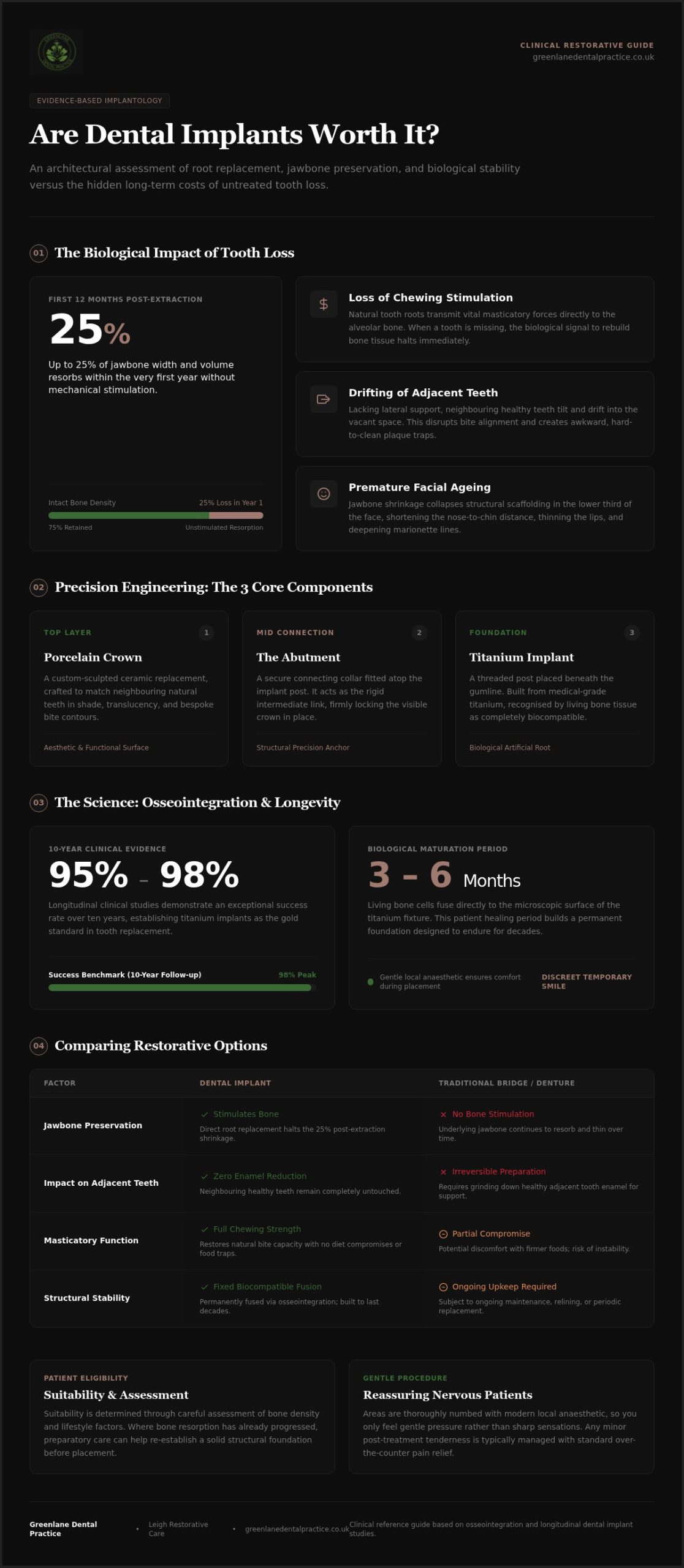
Living with a gap in your smile is rarely just a cosmetic inconvenience. Beneath the gumline, your jawbone relies on constant mechanical stimulation from chewing forces transmitted through natural roots. When a tooth is lost, that stimulation stops, triggering a biological process known as bone resorption. Within the first twelve months following an extraction, up to 25% of the surrounding jawbone width and volume can simply melt away. For anyone wondering are dental implants worth it, looking at what happens beneath the surface provides vital context.
As the bone diminishes, adjacent healthy teeth lose their lateral support. They begin to tilt and drift into the empty space, disrupting your bite and creating awkward traps for plaque. A dental implant prevents this cascade by functioning as an artificial root. A medical-grade titanium fixture is gently placed into the bone, creating a solid anchor for a bespoke porcelain crown. Exploring the science of osseointegration and dental implant mechanics reveals why replacing the root, rather than just the visible crown, offers an unmatched biological advantage over temporary fixes.
The Aesthetic Cost: Why Missing Teeth Age the Face
Your jawbone forms the foundational scaffolding for the lower third of your face, supporting lip fullness and facial muscle tone. As underlying bone tissue progressively recedes, that structural support collapses. The distance between your nose and chin gradually shortens, causing the lips to thin and fold inward. This premature skin laxity creates deep marionette lines around the mouth and an older, hollowed facial profile. Because dental implants stimulate the living bone tissue whenever you chew, they prevent this skeletal shrinkage and naturally preserve your youthful contours.
The Functional Impact on Your Daily Life
Day-to-day living with missing teeth carries subtle compromises. You might find yourself quietly ordering softer dishes when dining out in Leigh, avoiding crusty breads, nuts, or tender meats that require confident chewing. Gaps can also alter airflow, introducing slight whistling or lisps during conversation that undermine professional confidence. The psychological weight of covering your mouth when you laugh takes a genuine toll on your wellbeing. When evaluating are dental implants worth it, the investment must be weighed against this daily compromise; doing nothing often leads to complex bite collapse that costs far more to correct down the line.
How Dental Implants Work: The Science of a Permanent Smile
Modern implant dentistry relies on a remarkable biological event called osseointegration. First discovered in the 1950s, this process occurs when living bone cells attach directly to the microscopic surface of a medical-grade titanium fixture. Titanium is the universal gold standard across orthopaedics and dentistry because the human body recognises it as biocompatible rather than a foreign threat. As outlined in the FDA guidance on dental implants, this structural fusion provides a secure anchor that behaves just like a natural root, with longitudinal studies demonstrating a 95% to 98% success rate over ten years.
Each restoration relies on three distinct, precision-engineered components:
- The Implant: A small, threaded titanium post carefully placed beneath the gumline to anchor into the jawbone.
- The Abutment: A secure connecting collar that sits atop the post to support the visible tooth.
- The Porcelain Crown: A custom-sculpted ceramic replacement designed to match your neighbouring teeth in size, translucency, and shade.
Because osseointegration takes between three and six months to mature, this journey asks for a little patience. Yet that healing window is precisely why patients conclude that dental implants are worth it; taking time to establish an unbreakable foundation yields a solution built to last decades.
The Procedure: Reassuring the Nervous Patient
Fear of dental discomfort keeps many people from getting the care they need. During the procedure, the treatment area is completely numbed using modern local anaesthetic, meaning you feel gentle pressure but no sharp sensations. Most patients report that post-treatment soreness is easily managed with standard over-the-counter pain relief and subsides in a few days. You won’t leave with a gap, either; discreet temporary teeth protect your smile while healing occurs. If dental visits make you uneasy, learning about the calming, supportive approach at Greenlane Dental Practice can help put your mind at ease before taking the next step.
Bespoke Craftsmanship: Matching Your Natural Teeth
A successful restoration must feel indistinguishable from the teeth you were born with. Advanced digital impressions map every ridge and contour of your bite, ensuring your jaw aligns effortlessly without undue pressure. Clinical technicians shade-match the porcelain to your adjacent teeth, recreating natural colour gradients and surface textures. When asking are dental implants worth it, look at the dual benefit: you regain natural chewing strength whilst enjoying a confident, seamless smile.
Implants vs Bridges and Dentures: Comparing the Lifetime Value
Initial sticker price often distracts from the true cost of tooth replacement. While a dental bridge or removable acrylic denture may seem more economical at first glance, both options carry ongoing maintenance and eventual replacement cycles. Conventional dental bridges typically last between 10 and 15 years before recurrent decay beneath anchor crowns or structural failure demands a full remake. Removable appliances, as discussed in the NHS overview of dentures and tooth replacement options, require frequent adjustments or relining every five to eight years as your jaw changes shape.
When asking are dental implants worth it, comparing total lifetime value changes the calculation entirely:
| Feature | Dental Implant | Conventional Bridge | Removable Denture |
|---|---|---|---|
| Average Lifespan | 20+ years to lifetime | 10 to 15 years | 5 to 8 years |
| Bite Force Restored | 90% to 100% natural bite | 70% to 80% | 20% to 30% |
| Adjacent Tooth Impact | None (independent fixture) | Shaves 50%+ of healthy enamel | Clasps place stress on anchor teeth |
| Daily Maintenance | Normal brushing and flossing | Special floss threaders under pontic | Soaking, adhesives, nightly removal |
The Investment Breakdown: Upfront Cost vs ROI
Viewing treatment through a twenty-year lens brings clarity. A bridge that needs replacing twice over two decades rapidly overtakes the initial outlay of an implant. Implants also restore near-complete natural chewing force, whereas dentures restore only a fraction of that capability. Beyond the numbers, you gain uncompromised peace of mind. You never have to worry about an appliance slipping mid-sentence or clicking during dinner with friends.
Protecting Healthy Enamel
Traditional bridges come with a biological compromise: to bridge an empty space, a dentist must grind down 50% or more of the healthy enamel and dentin on both adjacent teeth. Once removed, that protective enamel is gone forever, leaving vulnerable anchor teeth prone to nerve irritation or decay. Prioritising tooth preservation is at the heart of modern preventative dental care. By standing entirely independently, an implant shields your neighbouring natural teeth from unnecessary trauma. When deciding are dental implants worth it, protecting your remaining healthy teeth is one of the most powerful reasons to say yes.
Assessing Suitability: Is a Dental Implant Right for You?
Most adults missing one or more teeth are viable candidates for restorative treatment. Success depends heavily on two structural requirements: sufficient healthy jawbone volume to anchor the fixture and healthy, infection-free gums. If a tooth has been missing for several years, bone resorption may have thinned the ridge. In these situations, gentle preparatory procedures such as bone grafting can rebuild the foundation before placement begins, ensuring the post receives optimal stability.
Your lifestyle and general health also influence how well the titanium integrates:
- Gum Health: Active periodontal disease must be treated and stabilised beforehand to prevent bacterial infection around the new fixture.
- Tobacco Use: Heavy smoking restricts local blood supply, roughly doubling the risk of early complications. Quitting or pausing smoking dramatically improves healing rates.
- Systemic Conditions: Well-managed health conditions rarely prevent treatment, though uncontrolled diabetes requires medical coordination first.
- Age: Age alone is rarely a barrier. Whether you are 28 or 82, adult bone retains the biological capacity to fuse with titanium.
Determining whether are dental implants worth it often comes down to this clinical foundation. Addressing underlying oral health issues beforehand ensures your new tooth lasts for decades to come.
The Role of Hygiene in Implant Success
Just like natural teeth, implants require consistent daily care to protect the supporting tissue. Bacterial plaque can cause peri-implant mucositis, which may progress to bone loss if neglected. Attending routine hygienist appointments in Leigh safeguards your investment. Modern techniques like the gentle EMS hygiene system use guided airflow and fine powders to clear harmful biofilm without scratching sensitive titanium surfaces, keeping your gums completely healthy.
Your Personalised Consultation in Leigh
Every restorative journey starts with an unhurried, thorough evaluation. During your initial assessment for dental implants Leigh, 3D digital scans map your bone contours and nerve pathways with pinpoint accuracy. This removes any guesswork, allowing for precise, minimally invasive placement. It is also your space to discuss personal priorities, explore flexible payment arrangements, and share any nerves with our caring team. If you are weighing up your options and asking are dental implants worth it, book a consultation with our friendly Leigh team today to discover what is possible for your smile.
Investing in Your Confidence at Greenlane Dental Practice
Choosing where to restore your smile is just as vital as deciding on the treatment itself. For residents across Leigh and Greater Manchester, accessing advanced restorative dentistry shouldn’t mean travelling into central Manchester or navigating cold, clinical spaces. At Greenlane Dental Practice, our care combines high-end clinical precision with the welcoming warmth of a home. We believe clinical authority works best when delivered with domestic comfort, making every visit reassuring from the moment you step through our doors on Manchester Road.
Your smile is uniquely personal, and so is our restorative approach. Often, an implant forms the centerpiece of a wider journey tailored to your long-term wellness. If neighbouring teeth have drifted out of alignment following years of tooth loss, straightening them first with Invisalign Leigh creates the ideal anatomical spacing before the implant post is placed. Combining these advanced disciplines under one roof ensures every element harmonises seamlessly, delivering an authentic result that looks and feels like you.
A Supportive Environment for Nervous Patients
Dental anxiety is entirely valid, particularly when contemplating surgical care. We organise our practice around your emotional comfort, using gentle communication that strips away baffling technical terms. Whether you require urgent attention from an emergency dentist Leigh or routine hygiene care, our team moves at your pace. We listen attentively to your worries, answer questions transparently, and never rush a treatment decision.
Next Steps: Restoring Your Smile in Leigh
Taking the first step is simple. Scheduling a suitability assessment gives you complete clarity on your treatment plan and the long-term health benefits for your bite. You don’t need extensive preparation for your initial consultation; bringing a note of any current medications and a clear idea of what you hope to achieve is all that’s required. When you weigh up the question are dental implants worth it, remember that investing in your smile restores far more than chewing ability. It brings back the freedom to laugh, speak, and enjoy meals out across Leigh with total peace of mind.
Reclaim Your Smile and Lifelong Confidence in Leigh
Living with missing teeth affects far more than your bite; it alters how you connect with others, how you enjoy meals, and how you feel about your reflection. Choosing to restore your mouth is an investment in both your oral health and daily wellbeing. When considering are dental implants worth it, the answer lies in their lasting stability, natural function, and unmatched ability to safeguard healthy jawbone tissue and surrounding teeth for decades to come.
At Greenlane Dental Practice, we have proudly served the Leigh community for decades. We pair advanced restorative expertise, including on-site EMS hygiene technology for meticulous long-term care, with a gentle, supportive focus on nervous patient comfort. You don’t have to navigate tooth loss or dental hesitation alone. Book your dental implant consultation in Leigh today and take the first reassuring step toward eating, speaking, and smiling with complete confidence once again.
Frequently Asked Questions
How long do dental implants actually last?
Dental implants are engineered to last a lifetime with proper care. While the titanium post fuses permanently with the jawbone, the custom porcelain crown attached to it experiences normal daily wear and tear. Most crowns last between 15 and 20 years before requiring minor refurbishment or replacement. Maintaining excellent daily hygiene and attending routine check-ups in Leigh will ensure your restoration remains fully functional for decades.
Is the dental implant procedure painful?
No, the placement procedure is carried out under local anaesthetic, ensuring you feel no pain throughout treatment. Most patients are pleasantly surprised by how comfortable the experience feels, describing mild pressure rather than sharp sensations. Any minor post-operative tenderness or gum swelling in the days following surgery is comparable to a routine extraction and easily managed with standard over-the-counter painkillers.
What is the success rate for dental implants in healthy adults?
Dental implants maintain an outstanding long-term clinical success rate of 95% to 98% in healthy adults. Because medical-grade titanium is naturally biocompatible, your bone cells fuse readily around the threaded fixture. Factors that influence long-term stability include good general health, non-smoking habits, and diligent oral hygiene. When evaluating are dental implants worth it, this remarkable predictability makes them the gold standard in modern tooth replacement.
Can I get dental implants if I have gum disease?
You cannot receive dental implants while active periodontal disease is present, but having gum disease in the past does not rule you out. Active infection compromises the supporting bone and soft tissue, threatening implant stability. At our Leigh practice, we treat and stabilise gum issues first through thorough deep cleaning and targeted periodontal care, establishing a clean, healthy foundation before planning your placement.
Are dental implants more expensive than a bridge in the long run?
While a traditional bridge usually requires a lower initial investment, dental implants frequently prove more cost-effective over a lifetime. Bridges typically need replacement or structural repairs every 10 to 15 years, and their preparation requires irreversibly filing down healthy neighbouring teeth. When people consider are dental implants worth it, avoiding repeated replacement costs and protecting adjacent enamel makes an implant an exceptionally sound long-term investment.
How do I clean and maintain my dental implants?
You look after a dental implant much like a natural tooth. Brush twice daily using a soft-bristled brush, clean between teeth daily with interdental brushes or floss, and avoid abrasive toothpastes. Regular professional maintenance is essential to prevent peri-implant bacterial buildup. In Leigh, we utilise gentle EMS hygiene technology, which lifts biofilm and calculus from titanium surfaces without scratching the delicate restoration.
What happens if my jawbone is too thin for an implant?
A narrow or receding jawbone does not automatically prevent you from having an implant. If bone resorption has occurred following tooth loss, we can perform a routine bone graft or sinus lift before placement. This regenerative treatment introduces mineral material to encourage natural bone growth, creating the necessary depth and width to support your new tooth securely for the long term.
Can I get a dental implant on the NHS?
Dental implants are exceptionally rare on the NHS. Funding is strictly reserved for extraordinary clinical circumstances, such as severe facial trauma, congenital cleft defects, or reconstruction following head and neck cancer. Standard tooth loss due to decay, wear, or gum disease does not qualify for NHS implants. Most patients in Leigh choose private care to access permanent, fixed implant restorations.