What is the best way to improve my smile without braces? It depends on what you’d like to change. If your teeth look darker, uneven or slightly out of position, you might be weighing up whitening, bonding, veneers or clear aligners. Avoiding fixed braces doesn’t necessarily mean ruling out orthodontic treatment: Invisalign uses clear aligners to move teeth.
Start by matching the option to your concern. Professional teeth whitening changes tooth colour, composite bonding can refine visible shape, porcelain veneers can change the appearance of selected teeth, and aligners address tooth position. These approaches have different purposes and considerations, and some involve more change to your natural teeth than others. A considered plan starts with your priorities, not a one-size-fits-all solution.
In this guide, we compare what each approach may help with, outline important limitations and explain how clear aligners differ from fixed braces. Greenlane Dental Practice in Leigh offers these smile-improvement options, alongside routine dental examinations, where you can discuss your priorities and consider a suitable next step.
Key Takeaways
- Identify whether you want to address colour, chips, shape, spaces or tooth position. This helps you focus the discussion on the change that matters most.
- Whitening can brighten teeth, but it won’t alter their shape or position. Other treatments address different concerns and have their own considerations.
- “Without braces” doesn’t always mean avoiding orthodontic treatment: clear aligners can move teeth without fixed braces.
- Prepare for a dental appointment by noting your priorities and questions. Reference images can help explain your preferences, but they don’t guarantee a particular result.
- Discuss how whitening, composite bonding, porcelain veneers and Invisalign could fit your goals with Greenlane Dental Practice in Leigh.
Improve your smile without braces by identifying what you want to change
Fixed braces aren’t the only starting point for a conversation about your smile. Before comparing treatments, identify what catches your eye: the colour of your teeth, a chip, their shape, a space or the way they sit. This concern-first approach helps distinguish a change to appearance from treatment intended to move teeth.
Improving your smile without fixed braces isn’t one specific treatment. It means choosing between approaches that address tooth colour, shape or position. Some options focus on how teeth look; clear aligners, by contrast, are an orthodontic approach that moves teeth. The broad category of cosmetic dentistry includes appearance-focused treatments, but the right direction depends on what you hope to change and an individual dental assessment.
Is the concern colour, shape, spacing or alignment?
Describe your concern in everyday language. If your teeth seem darker than you’d like, colour may be your main focus. If one tooth has a chipped edge or looks shorter or narrower than its neighbours, you may be concerned about shape. A visible gap could be the feature you notice most, while crowded teeth or teeth that sit at different angles may lead you to ask about position.
You may have more than one concern. Perhaps you’d like to brighten your teeth and address a small chip, or you notice both a gap and uneven positioning. That doesn’t automatically mean you need multiple treatments or that a particular option will suit you. It gives you a clearer way to explain what matters, so a dentist can discuss relevant possibilities and their considerations.
It can help to choose a main priority and a secondary one. For example: “I’d most like to improve the colour, but I’m also curious about this space.” This makes the discussion more useful than asking for a general smile makeover, because different treatments target different features.
What does “without braces” mean to you?
People use “braces” to mean different things. If you’d prefer not to have fixed brackets, removable clear aligners may still be worth discussing. Invisalign is a clear-aligner treatment that moves teeth, so it is orthodontic treatment even though it isn’t fixed metal braces.
Other options that don’t use fixed braces don’t move teeth. Whitening changes colour, while bonding or porcelain veneers may be discussed to change the visible shape or appearance of teeth. They shouldn’t be assumed to correct tooth position. Cosmetic changes and orthodontic movement have different aims, so being clear about which you want can make the conversation more focused.
- Colour: your teeth look darker or more stained than you’d prefer.
- Chips or shape: an edge is chipped, or a tooth looks uneven beside others.
- Spaces: a gap is the feature you’d most like to discuss.
- Position: your teeth look crowded, turned or unevenly aligned.
If you’re wondering how to improve my smile without braces, start with the feature you’d most like to change. You don’t need to know the treatment name. A clear description of your priorities is a sensible first step.
What can whitening, bonding, veneers and clear aligners actually change?
Once you’ve identified the feature you’d most like to address, compare options by their purpose. Some treatments change how teeth look; others are intended to move them. The distinction matters: professional whitening addresses tooth colour, for example, but it won’t change a tooth’s shape or position.
Use this overview to frame a conversation, rather than to diagnose your own smile. A dentist can assess your teeth and discuss which approaches may be suitable for your individual concerns.
| Option | Intended change and general approach | Question for your dental assessment |
|---|---|---|
| Professional teeth whitening | Lightens tooth colour through a professional whitening approach. It doesn’t alter tooth shape, spaces or position. | Is tooth shade my main concern, and is whitening suitable for me? |
| Composite bonding | Uses composite material to adjust the visible shape of a tooth, such as its outline or appearance. | Could bonding address the feature I’ve noticed, and what would it involve? |
| Porcelain veneers | A cosmetic option that changes the visible appearance of a tooth. | Would veneers be appropriate for my teeth and the change I want? |
| Invisalign clear aligners | Removable clear aligners intended to move teeth as orthodontic treatment. | Could aligners address my tooth-position concern? |
When might whitening, bonding or veneers be discussed?
If tooth shade is what you notice most, professional whitening may be an option to discuss. It targets colour, not the shape or position of teeth, so it won’t resolve a chip or crowding. Bonding uses composite material to alter a tooth’s visible shape, which may be relevant if you’re concerned about an edge or outline. Porcelain veneers are another cosmetic option, but they won’t suit everyone. An individual assessment helps establish what each approach could address in your case.
Can clear aligners help if you do not want fixed braces?
It may be possible to discuss tooth movement without fixed metal braces. Invisalign uses removable clear aligners to move teeth under dental supervision. That makes it different from fixed braces, but it is still orthodontic treatment, not simply a cosmetic way to change colour or tooth shape. Whether aligners could address your concern depends on an assessment. For more detail on this approach, explore the Invisalign Leigh complete guide.
Cosmetic treatments change the appearance of teeth; clear aligners are designed to move them. Keep that difference in mind as you compare ways to improve your smile without braces. Greenlane Dental Practice in Leigh offers these approaches, so you can discuss your priorities and how they relate to different treatments. You can discuss smile-improvement options in Leigh.
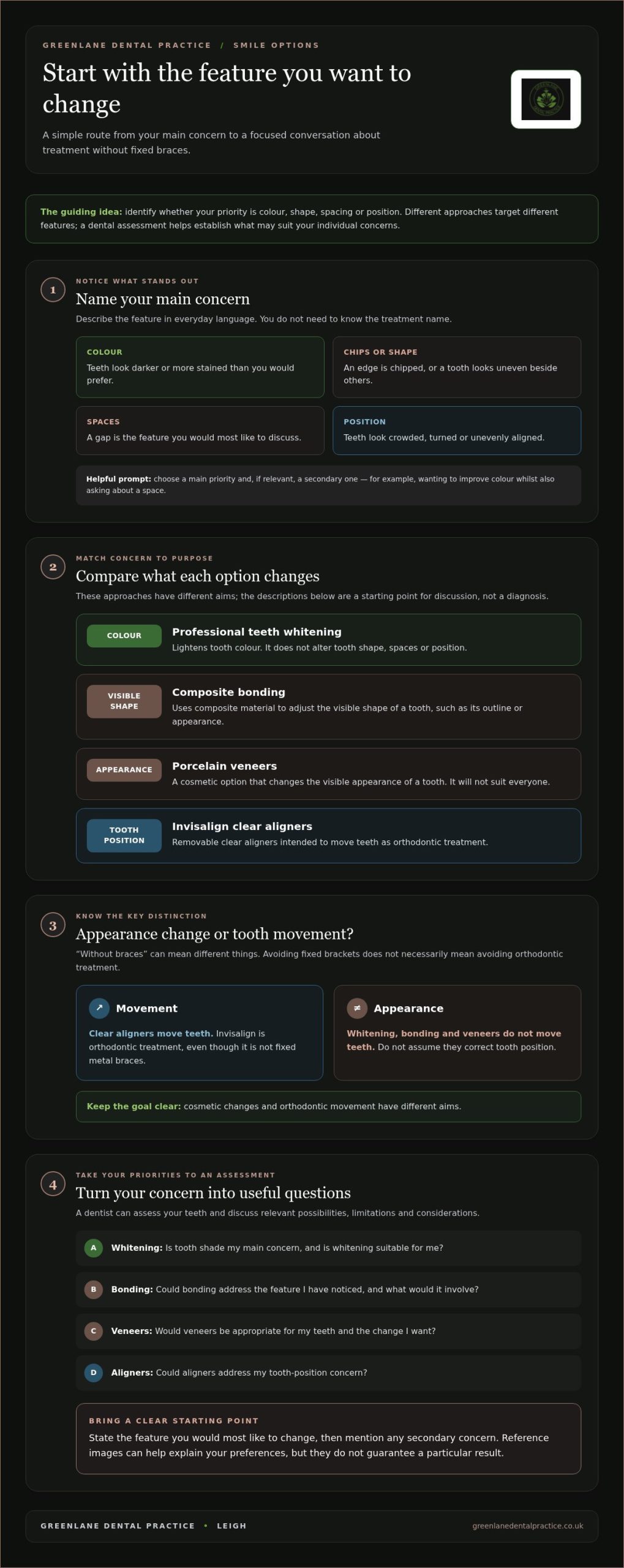
Compare braces-free smile options by treatment scope and trade-offs
“Without braces” can mean avoiding fixed brackets, but it doesn’t necessarily mean avoiding orthodontic treatment. Invisalign clear aligners are removable, yet they’re designed to move teeth. Whitening, composite bonding and porcelain veneers are cosmetic approaches: they change the appearance of teeth rather than repositioning them.
That distinction is central when choosing what to discuss. If your main concern is tooth position, an appearance-focused treatment may not address it. If you’re happy with how your teeth sit but want to explore their shade or shape, tooth movement may not match your priority. Neither category is automatically the better choice. The aim is to understand what each can and can’t change.
Appearance changes versus tooth movement
Whitening focuses on colour, while bonding and veneers can alter visible aspects of tooth shape or appearance. These options don’t move teeth into a new position. Clear aligners, by contrast, are orthodontic treatment intended to move teeth. If you’re concerned about how your teeth meet or sit, an assessment can help clarify the issue and which approaches may be relevant, without assuming a particular treatment will resolve it.
How to weigh treatment scope and commitment
Compare options by their purpose, the changes involved and how closely they match your main concern. Ask what a proposed treatment is intended to address, what it won’t change and whether there are relevant alternatives. The extent of treatment and its suitability depend on your individual dental circumstances, so a personalised assessment is more useful than a general ranking of options.
- Whitening: targets tooth shade, but not tooth position or shape. It may be worth discussing if colour is your main concern.
- Composite bonding: uses composite material to change the visible shape of a tooth. Its purpose isn’t to straighten teeth or address alignment.
- Porcelain veneers: offer a cosmetic way to change the visible appearance of teeth. Whether this option is appropriate, and what it would involve, depends on individual assessment.
- Invisalign clear aligners: are removable aligners used to move teeth. They avoid fixed brackets, but they are still orthodontic treatment and don’t whiten teeth.
You may have more than one concern to discuss, but that doesn’t mean you need to combine treatments. Ask the dentist to explain the scope of any suggested approach in relation to your priorities, along with its limitations and relevant alternatives. The composite bonding Leigh guide offers a focused explanation of bonding as an appearance-changing option.
If you’re considering how to improve my smile without braces, identify what you want a treatment to do rather than choosing by name alone. A personal discussion can help you weigh the options and understand their purpose. You can discuss your smile priorities with Greenlane Dental Practice in Leigh.
Prepare for a consultation about improving your smile without braces
A little preparation can help you make good use of a smile consultation. You don’t need to arrive knowing the name of a treatment. The aim is to explain what you’d like to change, understand the options and leave with a clearer sense of what each involves.
A consultation connects the treatment discussion to your individual needs, concerns and oral health. Use this simple sequence to organise your thoughts:
- Identify your concerns. Note the features you’re hoping to discuss, such as tooth shade, a chip, shape, spacing or alignment. If you have more than one concern, mark which matters most to you.
- Discuss your priorities. Explain what you hope will look different and what you’d prefer to avoid. For example, you might be interested in improving colour but want to understand whether other changes would be involved.
- Review the options. Ask which approaches could address your concern, what each is intended to change and what it won’t change. You can also ask about relevant alternatives and how they compare.
- Clarify follow-up. Before deciding, make sure you understand any suggested next steps, ongoing care or maintenance, and when your progress or oral health may need to be reviewed.
Questions to take into your smile consultation
It’s fine to bring a short list. Clear questions can help you understand the purpose and limits of a recommendation, rather than focusing only on the result you hope to see.
- Which part of my smile is this treatment intended to change?
- What won’t it change, and what alternatives could we discuss?
- How does the recommendation relate to my oral health or any existing dental concerns?
- What care or maintenance should I understand before making a decision?
These questions are useful whether you’re exploring a cosmetic option or clear aligners. A routine dental examination can also inform a discussion about your teeth and oral health before you consider a smile-improvement plan.
How to describe the result you are hoping for
Specific, everyday language is often more helpful than asking for a “perfect” smile. You might say you’d like a lighter-looking shade, a smoother-looking edge, a less noticeable space or to discuss how your teeth sit. Reference photographs can help show the colour or shape you prefer, but they’re a way to communicate, not a promise of an identical result. Your teeth and circumstances are unique.
If tooth shade is your main focus, the professional teeth whitening Leigh guide provides further context for your questions. For a broader discussion, bring your priorities to Greenlane Dental Practice in Leigh and explore them with a dentist. You can arrange a smile consultation.
Explore smile-improvement options with Greenlane Dental Practice in Leigh
You don’t need to decide on a treatment before you discuss your goals. Greenlane Dental Practice in Leigh offers professional teeth whitening, composite bonding, porcelain veneers and Invisalign, giving you several approaches to consider. A dentist can explain what each option is intended to change, take your individual circumstances into account and help you understand the choices.
Connect your main concern with the type of treatment discussion you want to have. The aim isn’t to select an option from a list on your own, but to arrive with a useful starting point and leave with a clearer understanding of what may be relevant for you.
Discuss the option that matches your main concern
If tooth shade is your priority, professional teeth whitening may be the subject to explore. For visible concerns about tooth shape, such as an uneven edge or a chip, composite bonding or porcelain veneers may be discussed. These are cosmetic approaches, and an assessment helps establish whether either is appropriate for your teeth and what the treatment would involve.
If tooth position is your main concern, Invisalign offers a clear-aligner approach to moving teeth. It differs from cosmetic reshaping: aligners are orthodontic treatment, even though they aren’t fixed metal braces. A dentist can discuss whether this type of tooth movement relates to your needs. Each option has a different purpose, so the most useful discussion begins with what you’d like to change.
Take a comfortable next step in Leigh
You can start simply by explaining what you notice and what you hope might look different. If you’re considering bonding for a visible shape concern, the composite bonding Leigh treatment guide offers a focused introduction. It can help you prepare questions, while a personal assessment provides the context to discuss your own teeth.
If you’re wondering how to improve my smile without braces, a conversation with a dentist can turn a broad question into a considered discussion of suitable options, their purpose and their limitations. Talk through your priorities, ask about professional whitening, bonding, veneers or Invisalign, and take time to understand the information before deciding what feels right.
Ready to explore your smile goals? Arrange a conversation with Greenlane Dental Practice in Leigh to discuss what you’d like to change and the options that may suit your individual needs.
Take the next step towards a smile that feels like yours
You don’t need to arrive with a treatment already chosen. A useful next step is to put your personal smile goals into words, including what you’d like to change and what matters most to you. That gives your dentist a starting point for a considered conversation about your needs and the options you’d like to understand.
If you’ve been wondering how to improve my smile without braces, remember that a suitable plan should reflect your individual circumstances, not someone else’s result or a trend. Take time to ask questions, weigh the information and feel comfortable with the direction you choose.
Greenlane Dental Practice offers cosmetic and restorative dentistry in Leigh, with a welcoming setting for discussing your smile goals. Arrange a conversation about your smile with Greenlane Dental Practice and take an informed step towards exploring what may suit you.
Frequently Asked Questions
Can I improve my smile without braces?
Yes, you can explore ways to improve your smile without braces, depending on what you’d like to change and your individual dental needs. You might want to discuss a brighter-looking shade, a chipped edge or tooth position. A dentist can assess your teeth and oral health, then explain which approaches may be relevant. At Greenlane Dental Practice in Leigh, you can talk through your priorities without arriving with a treatment already chosen.
Is Invisalign considered braces?
Invisalign isn’t fixed braces, but it is orthodontic treatment. It uses removable clear aligners to move teeth, so it may be an option to discuss if you want to avoid fixed brackets but are open to tooth movement. Whether it could address your particular concern depends on a dental assessment. If you’re unsure what you mean by “braces”, explain what you’d prefer to avoid and ask about the approaches available.
Can teeth whitening straighten crooked teeth?
No, teeth whitening won’t straighten crooked teeth because it changes colour, not tooth position. If one tooth appears darker and is also out of line, whitening may address the shade concern, but not its position. Mention both features during an assessment so they can be considered separately. A dentist can discuss whether professional whitening is relevant to the colour concern and whether tooth movement is worth exploring for alignment.
Can composite bonding close a gap between teeth?
Composite bonding may be discussed for some gaps because composite material can change the visible shape of a tooth. However, it doesn’t move teeth, and whether it’s suitable depends on the size and position of the space and your dental circumstances. A dentist can explain what bonding might change in your case and discuss alternatives, including whether the concern is better addressed through tooth movement rather than a change to tooth shape.
Are veneers a way to improve your smile without braces?
Yes, porcelain veneers are a cosmetic option that may change the visible appearance of teeth without fixed braces. They aren’t a method of moving teeth, so they may not address alignment as the main concern. Their suitability depends on an assessment of your teeth and what you hope to achieve. Ask the dentist to explain the proposed change, what veneers won’t address and whether another approach may better match your priorities.
How do I choose between whitening, bonding and veneers?
Start with the feature you want to address, then discuss the options with a dentist. Whitening may be relevant if your concern is tooth shade; bonding or veneers may be considered for visible shape changes. These treatments aren’t interchangeable, and the right discussion also depends on your teeth and oral health. Ask what each option involves, what it won’t change and what care or maintenance to understand before deciding.
Can I combine cosmetic dental treatments to improve my smile?
It may be possible to discuss more than one treatment, but a combination isn’t automatically needed or suitable. For instance, if you’re concerned about both shade and a chipped edge, ask whether those concerns call for separate approaches. A dentist can assess your oral health, explain how options might relate to one another and discuss any relevant sequence or alternatives. In Leigh, an individual conversation can help you understand the possibilities before deciding whether to proceed.