What if the most cost-effective way to replace a missing tooth is actually the option with the highest upfront price tag? When you’re weighing up a dental implant vs bridge, it’s easy to feel overwhelmed by technical jargon and the immediate financial commitment. You want a restoration that feels entirely like your own, fits into your daily life seamlessly, and won’t leave you back in the dental chair just a few years down the line.
We understand that the thought of surgery can be daunting, and nobody wants a replacement that looks “fake” or out of place. It’s completely natural to feel a bit anxious about making the wrong choice for your long-term health. This guide will help you discover the critical differences between these two treatments so you can make an informed, confident decision for your smile. We will explore how each option protects your remaining teeth, their expected lifespans, and which path leads to the permanent, natural-looking result you deserve.
Key Takeaways
- Understand the fundamental structural differences in a dental implant vs bridge, from how they are anchored to how they impact your surrounding natural teeth.
- Discover why implants are considered a long-term investment in your jawbone health, whilst bridges offer a faster, non-surgical route to a complete smile.
- Learn how choosing the right restoration can prevent facial structure changes by mimicking the function of a natural tooth root.
- Identify the specific clinical factors, such as bone density and gum health, that will determine which solution is most suitable for your unique smile.
- Explore why professional maintenance and personalised care plans are essential for ensuring your new restoration remains beautiful and functional for years to come.
Understanding Your Options: What Are Dental Implants and Bridges?
Losing a tooth is a deeply personal experience that goes far beyond a simple gap in your smile. It affects how you speak, what you choose to eat, and how you feel when you catch your reflection in the mirror. For many of our patients in Leigh, the physical change is often accompanied by a quiet loss of confidence. Modern dentistry has evolved to ensure that you don’t have to settle for a solution that feels temporary or looks unnatural. Instead, we focus on restorations that restore your quality of life whilst protecting your remaining natural teeth.
The decision usually comes down to a choice between a dental implant vs bridge. Both options are designed to fill the space and restore function, but they achieve this in very different ways. Whilst one acts as a standalone replacement, the other relies on its neighbours for support. Understanding these structural differences is the first step toward choosing a path that aligns with your lifestyle and long-term health goals.
Defining the Modern Dental Implant
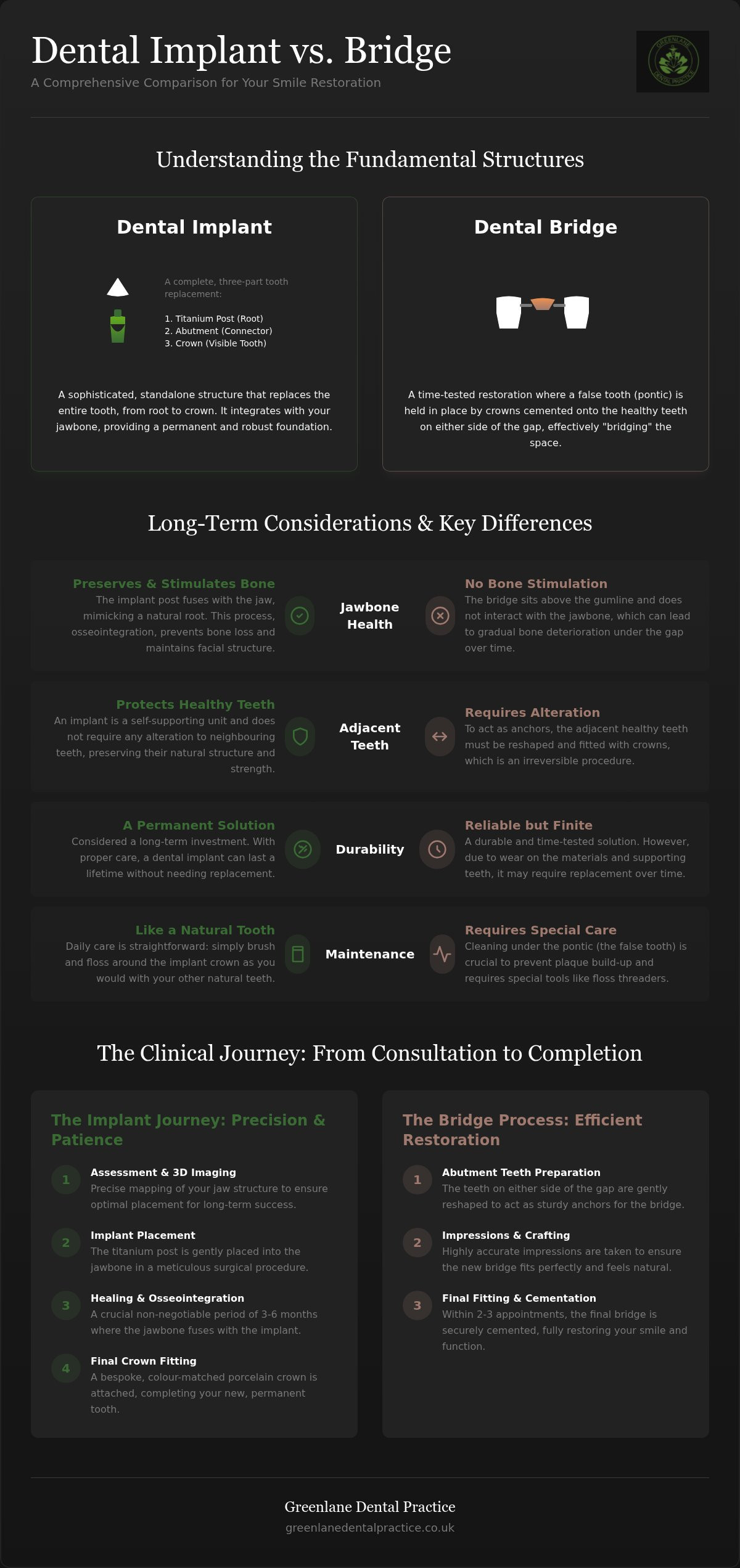
A dental implant serves as a sophisticated, permanent replacement for a missing tooth. It’s comprised of three distinct parts: a titanium post that sits beneath the gumline, an abutment connector, and a bespoke porcelain crown that matches your natural teeth. The magic of this solution lies in a biological process called osseointegration. Over several months, your jawbone actually fuses with the titanium post, creating a rock-solid foundation that mimics the strength of a natural tooth. A dental implant is the only solution that replaces the entire tooth structure, including the root.
Explaining the Traditional Dental Bridge
If you prefer a non-surgical alternative, a traditional dental bridge is a time-tested method for “bridging” the gap left by a missing tooth. This restoration consists of a false tooth, known as a pontic, which is held in place by dental crowns cemented onto the healthy teeth on either side of the space. It’s a fixed solution, meaning it stays permanently in your mouth unlike a removable denture. There are several variations tailored to different needs:
- Traditional Bridge: The most common type, using crowns on two adjacent teeth to support the replacement.
- Cantilever Bridge: Used when there is only one anchoring tooth available next to the gap.
- Maryland Bridge: A more conservative option that uses a metal or porcelain framework bonded to the back of neighbouring teeth.
Because a bridge sits above the gumline, it provides an immediate aesthetic result. However, it does require the supporting teeth to be prepared and reshaped to accommodate the crowns. This makes it a reliable choice for those who want a swift restoration without the healing period required for implants.
The Clinical Perspective: How Each Procedure Works
Understanding the physical journey of a dental implant vs bridge is essential for feeling at ease with your choice. At our practice, we prioritise your comfort from the moment you walk through the door. We know that dental anxiety often stems from the unknown. By breaking down the clinical steps, we aim to replace that uncertainty with a sense of calm and control. Whether you choose a surgical or non-surgical path, our team ensures the process is gentle, methodical, and tailored entirely to your needs.
The Implant Journey: Precision and Patience
The journey toward a permanent replacement begins with a thorough clinical assessment. We utilise advanced 3D imaging to map your jaw structure with absolute precision, ensuring the ideal placement for long-term success. This level of detail is vital for understanding how dental implants and bridges work within your unique anatomy. Once the titanium post is placed, a healing period of three to six months follows. This phase is non-negotiable; it’s the time required for your bone to bond with the implant. Finally, we fit a bespoke crown, meticulously crafted to match the colour and contour of your surrounding teeth for a seamless finish.
The Bridge Process: Efficient Restoration
If you are looking for a swifter result, the bridge process is remarkably efficient. Unlike implants, a bridge does not require a healing period for bone bonding. Instead, we focus on preparing the “abutment” teeth on either side of the gap. These teeth are gently reshaped to act as sturdy anchors for the new restoration. We take highly accurate impressions to ensure your new bridge feels natural and comfortable. Within just two or three appointments, your ability to eat and speak with confidence is fully restored. If you are curious about how these steps might fit into your schedule, our team is always here to discuss your restorative options in a relaxed, friendly setting.
Comparing Treatment Timelines
The most significant difference in the dental implant vs bridge experience is the “time to tooth.” A bridge can often be completed in as little as two weeks, making it an attractive option for those with upcoming events or a preference for immediate results. Implants require a longer commitment, typically spanning several months to allow for osseointegration. This timeline can be influenced by your individual healing rate and bone density. Whilst bridges offer speed, implants provide a lifetime of stability. We manage every step with local anaesthesia and a patient-first approach to ensure you remain comfortable, regardless of the duration of your treatment.
Long-Term Considerations: Aesthetics, Durability, and Oral Health
Choosing between a dental implant vs bridge isn’t just about filling a gap for today. It’s an investment in your future facial structure and the health of your remaining teeth. Whilst both options deliver a beautiful aesthetic result, their impact on your oral biology differs significantly over time. We believe in providing solutions that don’t just look natural but also function in harmony with your body for decades to come.
Jawbone Preservation and Facial Structure
When you lose a tooth, the underlying jawbone begins a process called resorption. Without the stimulation provided by a natural tooth root, the bone gradually thins and shrinks. This often leads to a “sunken” facial appearance that can prematurely age your features. Dental implants are the only restoration that addresses this biological shift. By mimicking a natural root, the titanium post encourages the bone to remain dense and strong. Bridges, whilst effective at restoring your smile’s surface, sit above the gumline and cannot prevent this underlying bone loss. For many of our patients in Leigh, preserving their natural face shape is a deciding factor in choosing an implant.
Impact on Surrounding Natural Teeth
The “neighbouring tooth” dilemma is a vital consideration for your long-term health. A traditional bridge requires us to remove healthy enamel from the teeth on either side of the gap to create room for the supporting crowns. This process is permanent. Once that enamel is gone, those teeth will always require protection. In contrast, an implant is a standalone solution. It leaves your neighbouring teeth completely untouched, preserving their natural strength. Research suggests that dental implants have a 10-year survival rate of approximately 95 to 97 per cent, whilst traditional bridges typically sit around 89 to 90 per cent. Choosing an implant often means protecting the integrity of your entire smile.
Lifestyle and Maintenance Requirements
Daily life feels remarkably different depending on your choice. An implant feels, bites, and brushes exactly like a natural tooth. You can eat your favourite foods and speak with total confidence, knowing the restoration is anchored firmly in place. Bridges require a slightly different hygiene routine, as you’ll need to clean underneath the false tooth to prevent plaque build-up. At our practice, we recommend regular hygiene appointments to ensure both types of restoration remain in peak condition. Whether you choose an implant or a bridge, our team uses advanced technology like the EMS hygiene system to keep your smile healthy and vibrant. Regular check-ups allow us to monitor the fit and function of your restoration, ensuring it continues to serve you well for years to come.
Decision Framework: Factors That Influence Your Choice
Choosing between a dental implant vs bridge is a deeply personal decision that balances your clinical needs with your lifestyle and long-term goals. There is no universal “best” option; the right choice is the one that aligns with your unique circumstances. We believe in providing you with all the facts so you can feel empowered and confident in your dental journey. By looking at your health, habits, and budget, we can help you navigate the path to a restored smile that feels entirely like your own.
Assessing Your Oral Health and Bone Density
The success of an implant depends heavily on the foundation of your jaw. Because the titanium post must fuse with the bone, having sufficient bone volume is critical. If you’ve been missing a tooth for an extended period, the bone may have thinned, but this doesn’t necessarily rule you out as a candidate. We often perform bone grafting or sinus lifts to rebuild the area and create a stable environment for the implant. These advanced techniques allow us to help patients who might have been told elsewhere that they aren’t suitable for implants. We also meticulously check your gum health, as a healthy soft-tissue environment is essential for preventing infection and ensuring your restoration lasts for decades.
Evaluating Your Budget and Long-Term Value
Financial considerations are a practical part of any healthcare decision. A dental bridge typically has a lower upfront cost and a faster completion time, which can be an attractive solution for many. However, it’s vital to consider the “cost per year” over your lifetime. A traditional bridge usually requires replacement every 10 to 15 years. Conversely, while an implant requires a larger initial investment, it’s designed to be a permanent solution. When you factor in the potential for a lifetime of use without the need for replacement, the dental implant vs bridge comparison often shows that implants provide greater long-term value. We take pride in being transparent about these costs, helping our Leigh community make investments that make sense for their futures.
Your daily habits and medical history also influence the decision-making process. For instance, smoking can affect the body’s ability to heal and may impact the success of the osseointegration process. Similarly, conditions like uncontrolled diabetes require careful management before proceeding with surgical options. This is why a personalised consultation is non-negotiable. We take the time to listen to your concerns and understand your health profile in a warm, non-judgmental environment. Ready to discover which solution is right for you? Book your restorative consultation at our Leigh practice to receive a bespoke treatment plan tailored to your smile.
Personalised Care in Leigh: Restoring Your Confidence at Greenlane
At Greenlane Dental Practice, we believe your journey to a new smile should be as comfortable as it is life-changing. Choosing between a dental implant vs bridge is a significant milestone. You aren’t just a patient on a clinical list here; you’re a member of our local Leigh community. We take immense pride in blending advanced clinical precision with a warm, neighbourly atmosphere that makes you feel right at home from the moment you step through our doors.
Our Restorative Expertise in Leigh Manchester
Our modern clinic in the heart of Leigh is designed to alleviate the anxieties often associated with restorative work. We’ve created a space that feels more like a supportive community hub than a sterile medical environment. When you meet our team of empathetic experts, you’ll find meticulous caretakers who value your unique journey. We don’t believe in “one size fits all” dentistry. Every treatment plan is bespoke, crafted with your specific aesthetic goals and lifestyle in mind. Whether we are planning a single implant or a multi-unit bridge, we use digital diagnostics to ensure your results are both beautiful and functional.
Integrating EMS Hygiene for Long-Term Success
Protecting your investment is just as important as the procedure itself. We’ve invested in the advanced EMS hygiene system to ensure your long-term success. This technology is a game-changer for maintaining both implants and bridges. It uses pain-free Airflow cleaning to gently remove biofilm and staining without the scraping associated with traditional methods. This is particularly beneficial for the delicate gum tissues around a new implant or underneath a bridge. By creating a preventative care routine tailored to your restoration, we help you keep that natural-looking smile healthy for years to come.
Taking the first step toward restoring your smile doesn’t have to be daunting. During your initial restorative consultation, we’ll sit down with you for a relaxed, thorough discussion about your options. We’ll listen to your concerns about the dental implant vs bridge choice, perform a gentle examination, and answer any questions you have about timelines or maintenance. Our goal is to ensure you feel informed, cared for, and excited about the future of your smile. We’re ready to guide you with kindness and expertise every step of the way.
Take the Next Step Toward Your Confident New Smile
Choosing between a dental implant vs bridge is a significant decision that impacts your oral health for years to come. Whether you prioritise the long-term biological preservation of a dental implant or the efficient, non-surgical restoration of a bridge, your choice should lead to a smile that feels completely like your own. We’ve explored how each option works, from the structural integrity of titanium posts to the convenience of anchored crowns, and how your lifestyle influences the final path.
At Greenlane, we combine expert restorative care in Leigh with advanced EMS Airflow hygiene technology to ensure your new smile stays vibrant. We understand that dental work can feel daunting, which is why we provide empathetic support for nervous patients in a warm, welcoming environment. You don’t have to navigate these choices alone; our team is here to guide you with kindness and clinical precision. Book your restorative consultation at Greenlane Dental Practice today and rediscover the confidence of a complete, natural-looking smile. We look forward to welcoming you into our community.
Frequently Asked Questions
Is a dental implant better than a bridge for a single missing tooth?
An implant is often considered the gold standard for a single missing tooth because it doesn’t require the preparation of neighbouring healthy teeth. Unlike a bridge, which relies on anchors, an implant is a standalone solution that mimics a natural root. This prevents bone loss and maintains your facial structure. However, the best choice in the dental implant vs bridge debate depends on your specific oral health and bone density, which we assess during your consultation.
How long does a dental bridge typically last compared to an implant?
A traditional dental bridge typically has a lifespan of 10 to 15 years before it may need replacing due to wear or decay in the anchor teeth. In contrast, dental implants are designed to be a permanent, once-in-a-lifetime investment. Research shows they have a survival rate of up to 98 per cent. Whilst the crown on top of an implant may eventually need maintenance, the titanium post can last for many decades with proper care.
Are dental implants painful to have fitted?
Most patients find the procedure much more comfortable than they anticipated. We use local anaesthesia to ensure the area is completely numb during the placement, so you shouldn’t feel any pain during the surgery itself. After the treatment, it’s normal to experience some mild swelling or tenderness for a few days, which is easily managed with standard over-the-counter pain relief. Our empathetic team is always on hand to support you throughout the healing phase.
Can I get a bridge if my surrounding teeth are not strong enough?
A traditional bridge requires strong, healthy teeth on either side of the gap to act as anchors. If these teeth are weakened by decay, large fillings, or gum disease, they may not be able to support the restoration safely. In such cases, a dental implant is often the more reliable choice as it doesn’t place any strain on your remaining teeth. We’ll carefully evaluate the health of your smile to determine which solution offers the most stability.
What happens if I don’t replace a missing tooth at all?
Leaving a gap can lead to several long-term issues beyond just the appearance of your smile. Your remaining teeth will naturally start to tilt or shift into the empty space, which can cause bite misalignment and jaw pain. Additionally, the jawbone in that area will begin to shrink through resorption since it’s no longer being stimulated by a tooth root. This can eventually affect your facial structure and make future restorative treatments more complex.
How much does a dental implant cost in Leigh Manchester?
The cost of a dental implant varies depending on the complexity of your case and whether you require additional treatments like bone grafting. Whilst we don’t provide fixed prices without an examination, we focus on the long-term value of implants as a permanent solution. During your restorative consultation at our Leigh practice, we’ll provide a clear, bespoke breakdown of the investment required for your specific journey, helping you choose between a dental implant vs bridge with total confidence.
Can a bridge be replaced with an implant later on?
Yes, it’s often possible to replace an old or failing bridge with a dental implant. However, because bridges don’t prevent bone loss, we may need to assess whether you have enough jawbone density remaining to support the implant post. If the bone has thinned over the years, we can often perform a bone graft to rebuild the area. This transition is a common way for patients to upgrade to a more permanent and standalone tooth replacement.
How do I clean and maintain my dental bridge or implant?
Maintenance is essential for the longevity of both restorations. For an implant, you simply brush and floss it like a natural tooth. A bridge requires a bit more care, as you’ll need to use interdental brushes or specialised floss to clean underneath the false tooth. We also recommend regular hygiene appointments at our Leigh practice. Our advanced EMS hygiene system is particularly effective at gently cleaning around restorations, ensuring your gums stay healthy and your new smile remains vibrant.